Ramayana — The journey of Rama — twenty-one episodes after Valmiki
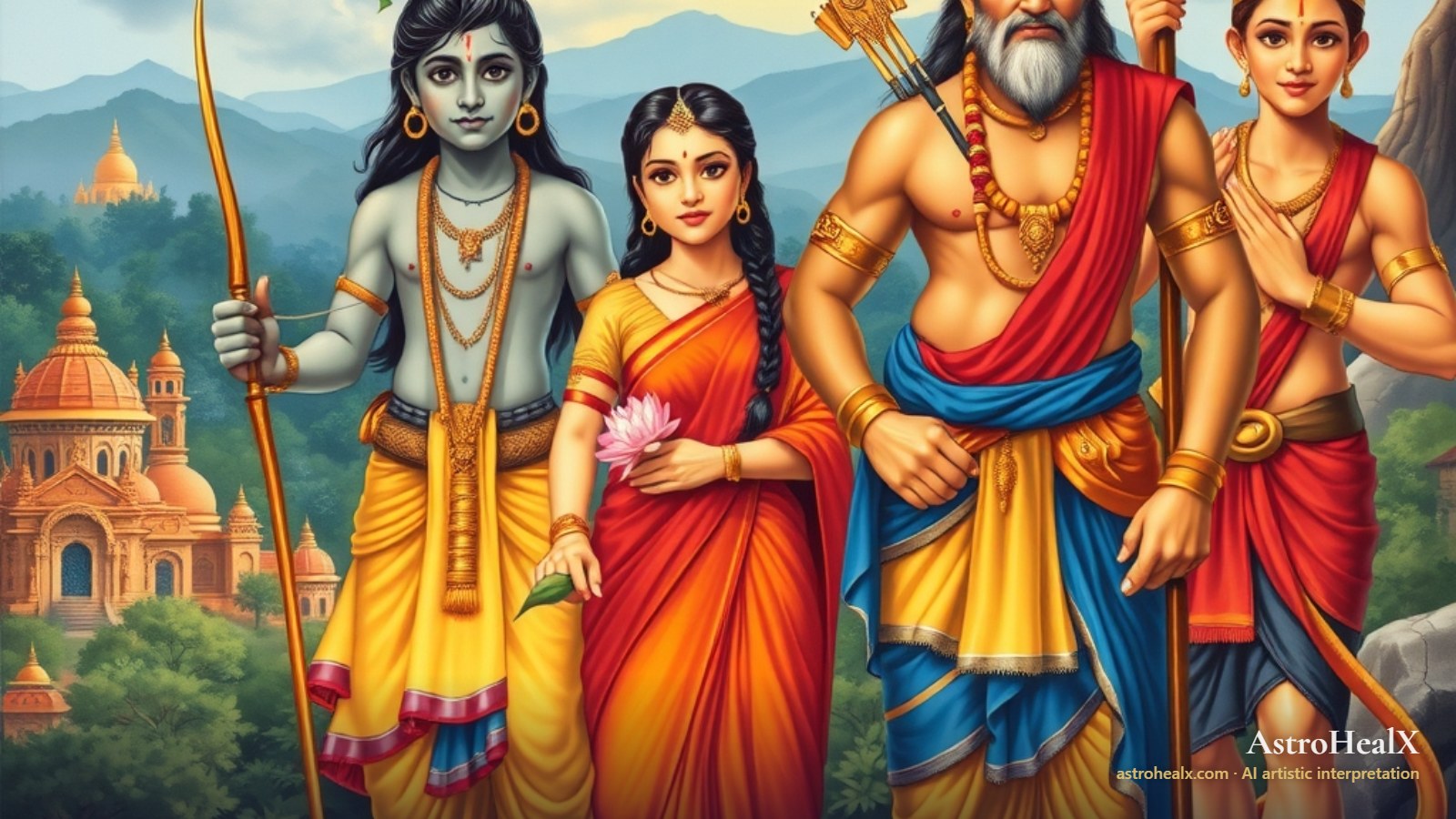
Some twenty-four thousand verses, composed by the sage Valmiki perhaps 2,500 years ago, tell how a prince of Ayodhya kept his father's word, lost his wife to the king of Lanka, and won her back with an army of forest-dwellers. It is the story India has told its children longest: about promises, exile, friendship, and what a good person does when every choice costs something.
Narrative follows the Valmiki Ramayana (Baroda Critical Edition, 7 kandas). Where the Ramcharitmanas of Tulsidas (1574), the Kamba Ramayanam (Tamil, 12th c.) or the Adhyatma Ramayana differ, the episode says so. No verses or dialogues are invented; dialogue is paraphrased from the text.
Bala Kanda — Boyhood
- The Story of the Ramayana — A bandit became a poet, and a bird's cry became the first verse.
- Birth of Lord Rama — A king with three queens and no heir sends for a sage who was raised by deer.
- Childhood and Education — Four brothers, two pairs, one teacher — and a father who cannot look away from his eldest.
- Vishwamitra and the Protection of the Yajna — The first arrow Rama shoots in the epic does not kill — it carries its target a hundred leagues away.
- Sita's Swayamvara and the Breaking of Shiva's Bow — Five thousand men could barely drag the bow into the hall. A boy picks it up to look at it.
- The Marriage of Rama and Sita — Two royal houses are joined four times over — and then an axe-bearing sage appears with a second bow.
Ayodhya Kanda — The Exile
- The Events Leading to Exile — The city is decorated for a coronation. By dawn the garlands will be for a funeral of hope.
- Rama, Sita and Lakshmana Leave Ayodhya — "A wife's place is her husband's shadow — in a palace or in a forest."
- Dasharatha's Death and Bharata at Chitrakoot — The prince who was given a kingdom walks barefoot for days to give it back.
Aranya Kanda — The Forest
- Life in the Forest, Surpanakha and the Golden Deer — Thirteen peaceful years end with a laugh at the wrong woman.
- The Abduction of Sita — An old vulture fights a king in the sky, and loses.
Kishkindha Kanda — The Alliance
- Meeting Hanuman and Sugriva — A monkey in a brahmin's disguise speaks such perfect Sanskrit that Rama stops grieving to admire it.
- Vali's Death and the Search for Sita — The most argued-over arrow in Indian literature.
Sundara Kanda — Hanuman's Leap
- Hanuman's Journey to Lanka — He grows until the mountain sinks under his feet, and then he jumps.
- The Burning of Lanka — The prisoner refuses to be rescued — and the messenger decides to leave a message the whole city can read.
Yuddha Kanda — The War
- Vibhishana's Choice and the Building of Ram Setu — A bridge of stones across a hundred yojanas of sea, built in five days by monkeys — and by a squirrel.
- The Great War in Lanka — A mountain of herbs flies across the sky in the hands of a monkey, because a brother will not wake.
- Ravana's Defeat — "Between Rama and Ravana there is only one comparison — Rama is like Rama, and Ravana like Ravana."
- The Return to Ayodhya — From the air, Rama shows Sita every place she passed as a prisoner — now as a queen.
- Rama's Coronation — Ram Rajya: eleven thousand years in which no child died before its parents.
Uttara Kanda — Afterwards
- Uttara Kanda — The Later Events — The poet who began the story walks into it, holding the hands of two boys who are singing it.
हिंदी में
लगभग चौबीस हज़ार श्लोक, ऋषि वाल्मीकि द्वारा शायद ढाई हज़ार वर्ष पहले रचित, बताते हैं कि अयोध्या के एक राजकुमार ने पिता का वचन निभाया, लंका के राजा से पत्नी खोई, और वनवासियों की सेना के साथ उसे वापस पाया। यह वह कथा है जो भारत ने अपने बच्चों को सबसे लंबे समय से सुनाई है: वचन, वनवास, मित्रता, और यह कि जब हर चुनाव की कीमत हो तो अच्छा व्यक्ति क्या करता है।
This page is the readable version. The interactive view has the full reader, search and related tools.
Open in AstroHealX