Ramayana · Episode 5: Sita's Swayamvara and the Breaking of Shiva's Bow
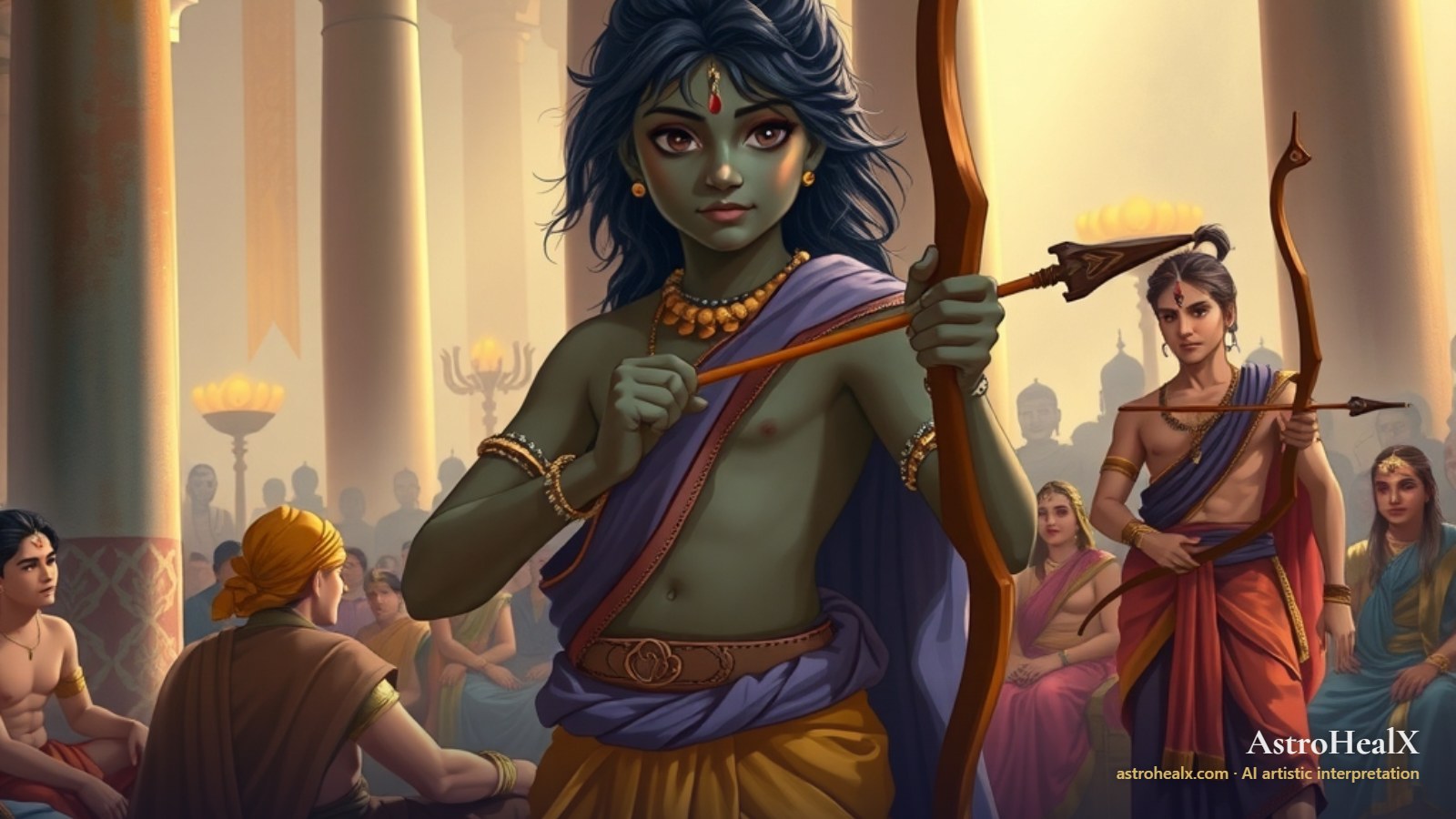
Five thousand men could barely drag the bow into the hall. A boy picks it up to look at it. · 9 min · 4 scenes
Scene 1
On the way to Mithila the sage tells the story of each place — the descent of the Ganga, the birth of Kartikeya — and at a deserted hermitage near the city, the story of Ahalya: Gautama's wife, deceived (in Valmiki she recognises Indra and consents) and cursed to live unseen, eating air, until Rama should come. Rama touches her feet; she becomes visible; Gautama takes her back. Later poets turned her to stone; Valmiki made her invisible, which is crueller and more human.
Scene 2
Janaka, philosopher-king of Videha, receives them. He tells of the bow: given by Shiva to his ancestor Devarata, kept in an iron chest on an eight-wheeled cart, and of the girl he found in a furrow while ploughing the sacrificial field — Sita, "the furrow", whom he has sworn to give only to the man who can lift the bow. Kings came, failed, besieged Mithila for a year in rage, and left.
Scene 3
Five thousand tall men haul the cart into the hall. Rama asks the sage's permission, then Janaka's, opens the chest, lifts the bow in one hand as if it were a toy, strings it — and as he draws, it breaks in the middle with a sound like a mountain splitting. The assembly falls to the ground; only Janaka, Vishwamitra and the two brothers stay standing. "My daughter," says Janaka, "is won."
Scene 4
In Valmiki there is no swayamvara crowd on the day and no garden meeting beforehand: Rama and Sita have not seen each other when the bow breaks. It is Tulsidas who gives the world the Phulwari — Sita gathering flowers for Gauri's shrine, Rama seeing her across the garden, the glance that both of them keep — and the Kamba Ramayanam that makes their first look a lightning strike. Different poets, different hearts; the marriage is the same.
What happened
Rama frees Ahalya, reaches Mithila, and breaks Shiva's bow, winning Sita, Janaka's daughter of the furrow.
Why it matters
Janaka's test was never about strength alone: a man who asks permission twice before touching the bow is being measured as much as his arm.
What happens next
Dasharatha comes to Mithila; four brothers marry four sisters; an angry Parashurama blocks the road home.
Sita was born of the earth, not of a mother. What does that say about who she belongs to?
हिंदी में — सीता स्वयंवर और शिव-धनुष भंग
मिथिला के मार्ग पर ऋषि हर स्थान की कथा कहते हैं — गंगावतरण, कार्तिकेय-जन्म — और नगर के पास निर्जन आश्रम में अहल्या की: गौतम-पत्नी, छली गई (वाल्मीकि में वे इंद्र को पहचानती हैं और सहमत होती हैं) और शाप पाती हैं कि अदृश्य रहें, वायु पर जिएँ, जब तक राम न आएँ। राम उनके चरण छूते हैं; वे दृश्य होती हैं; गौतम उन्हें अपना लेते हैं। परवर्ती कवियों ने उन्हें शिला बनाया; वाल्मीकि ने अदृश्य — जो अधिक क्रूर और अधिक मानवीय है।
विदेह के दार्शनिक-राजा जनक उनका स्वागत करते हैं। धनुष की कथा कहते हैं: शिव ने पूर्वज देवरात को दिया, आठ पहियों के रथ पर लोहे की पेटी में रखा; और उस कन्या की जो यज्ञ-भूमि जोतते हल की रेखा में मिली — सीता, "हल-रेखा" — जिसे उन्होंने केवल उसे देने की शपथ ली जो धनुष उठा सके। राजा आए, असफल हुए, क्रोध में वर्षभर मिथिला घेरी, लौट गए।
राम अहल्या को मुक्त करते हैं, मिथिला पहुँचते हैं, शिव-धनुष तोड़कर हल-रेखा से जन्मी जनक-पुत्री सीता को पाते हैं।
Sources: Valmiki Ramayana, Bala Kanda, sargas 48–67 · Ramcharitmanas, Bala Kanda (Phulwari); Kamba Ramayanam (first sight). Modern retelling, not translation; "variant" marks regional or later additions. Images are AI artistic interpretations.
‹ Episode 4: Vishwamitra and the Protection of the Yajna · Episode 6: The Marriage of Rama and Sita ›
This page is the readable version. The interactive view has the full reader, search and related tools.
Open in AstroHealX