Ramayana · Episode 4: Vishwamitra and the Protection of the Yajna
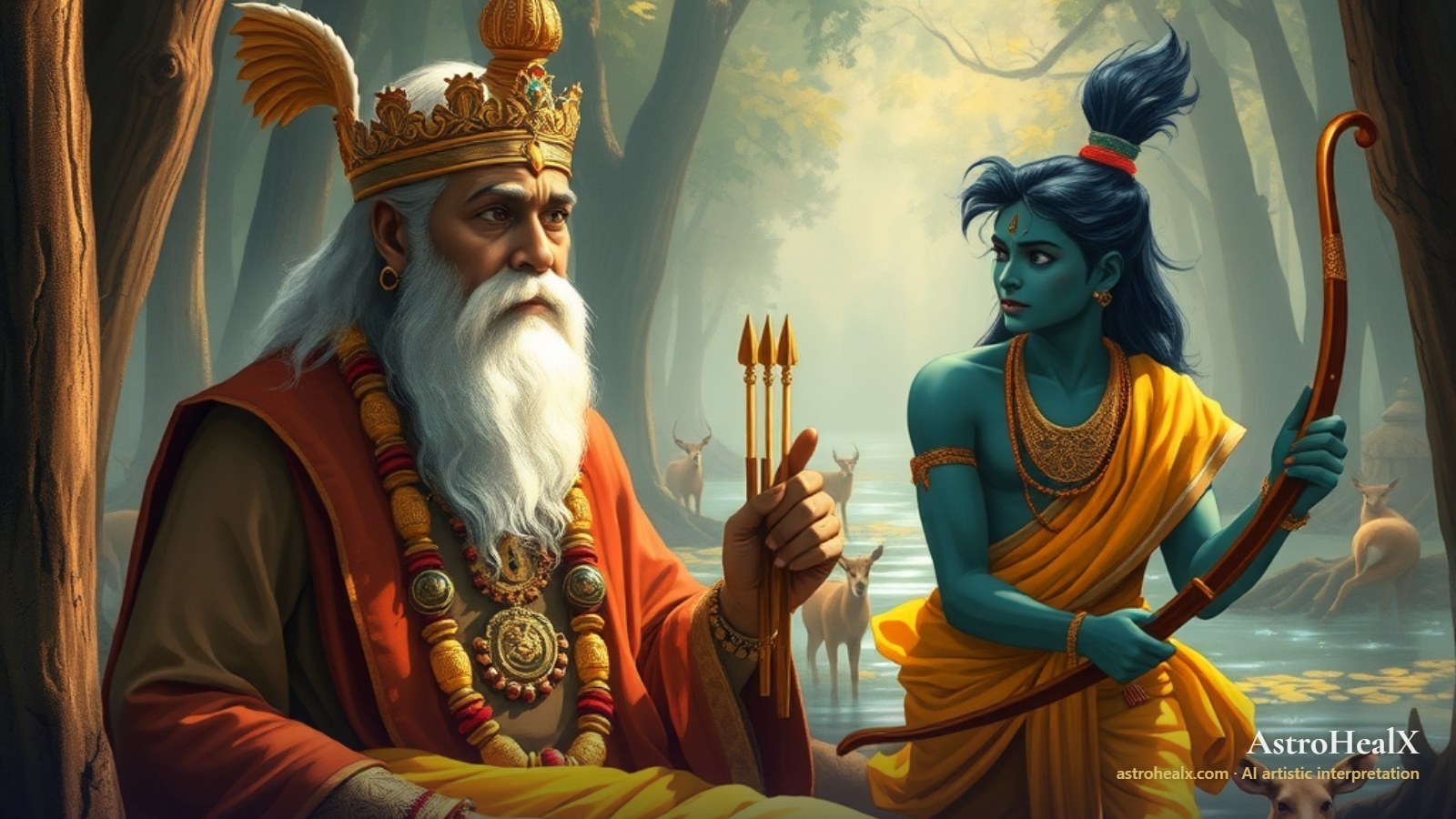
The first arrow Rama shoots in the epic does not kill — it carries its target a hundred leagues away. · 10 min · 5 scenes
Scene 1
Vishwamitra's request: two demons, Maricha and Subahu, defile his sacrifice with blood and flesh; he may not curse while under the vow; lend me Rama for ten nights. Dasharatha, white with fear, offers his whole army, offers himself — Rama is a child, not sixteen, and Ravana's people are not boys' work. Vishwamitra's anger shakes the earth. Vasishtha speaks: the sage knows every weapon in the three worlds; the boy will be safer with him than in the palace. Dasharatha yields.
Scene 2
Rama and Lakshmana follow the sage out of Ayodhya on foot, bows on their shoulders, a strange sight — princes walking behind a hermit. On the bank of the Sarayu Vishwamitra teaches them two mantras, Bala and Atibala: no hunger, no thirst, no fever, no fatigue, no fear in sleep. The education that Vasishtha began, the wild sage completes.
Scene 3
They enter a dead forest. This was two prosperous kingdoms, the sage says, until the yakshini Tataka — cursed with a demon's form by Agastya — made it a desert. Kill her. Rama hesitates: she is a woman. Vishwamitra answers with precedent — Indra killed Manthara, Vishnu killed Bhrigu's wife — the protection of the people outweighs the scruple. Rama strings his bow. The twang alone is enough to bring Tataka charging; the fight ends at dusk with a single arrow through her chest. The forest flowers again by morning.
Scene 4
Pleased, Vishwamitra gives Rama the divine weapons — the discus of Vishnu, the trident of Shiva, the noose of Varuna, the weapons of fire, wind and sleep, and the means to call them back. They come to him "like servants, with folded hands". Rama asks for the withdrawing mantras as eagerly as the launching ones; the poet notes it.
Scene 5
At Siddhashrama the sacrifice begins; for six days and nights the brothers stand guard without sleep. On the sixth day the sky fills with blood and Maricha and Subahu appear. Rama does not kill Maricha: the Manava weapon hurls him a hundred yojanas into the ocean, alive. Subahu he burns with the Agneya weapon. The choice to spare Maricha will return, years later, as a golden deer.
What happened
Dasharatha lends Rama to Vishwamitra; Rama kills Tataka, receives the divine weapons, and protects the sacrifice, sparing Maricha.
Why it matters
Rama's first moral test is not courage but scruple — killing a woman — and the epic has him reason it through rather than simply obey.
What happens next
On the road to Mithila, a stone becomes a woman, and a bow no king can lift waits in a palace.
Rama spares Maricha, who will later cause Sita's abduction. Was mercy the mistake, or was it still right?
Wisdom from the epic — Learning to withdraw a weapon
Rama asks for the mantras that recall a weapon as eagerly as those that release it. Power that cannot be taken back — a word, a message, an action in anger — is not mastery. The mark of training is the ability to stop.
हिंदी में — विश्वामित्र और यज्ञ-रक्षा
विश्वामित्र की माँग: दो राक्षस, मारीच और सुबाहु, मेरे यज्ञ को रक्त-मांस से अपवित्र करते हैं; व्रत में मैं शाप नहीं दे सकता; दस रात्रियों के लिए राम मुझे दो। भय से श्वेत दशरथ पूरी सेना देते हैं, स्वयं को देते हैं — राम बालक हैं, सोलह के भी नहीं, और रावण के लोग बालकों का काम नहीं। विश्वामित्र के क्रोध से धरती काँपती है। वसिष्ठ कहते हैं: ऋषि तीनों लोकों के हर अस्त्र को जानते हैं; बालक महल से अधिक उनके पास सुरक्षित रहेगा। दशरथ मान जाते हैं।
राम-लक्ष्मण पैदल ऋषि के पीछे अयोध्या से निकलते हैं, कंधों पर धनुष, विचित्र दृश्य — राजकुमार एक तपस्वी के पीछे। सरयू-तट पर विश्वामित्र दो मंत्र सिखाते हैं, बला और अतिबला: न भूख, न प्यास, न ज्वर, न थकान, न निद्रा में भय। जो शिक्षा वसिष्ठ ने आरंभ की, वन का ऋषि पूरी करता है।
दशरथ राम को विश्वामित्र को सौंपते हैं; राम ताटका का वध करते हैं, दिव्यास्त्र पाते हैं, यज्ञ की रक्षा करते हैं, मारीच को छोड़ देते हैं।
Sources: Valmiki Ramayana, Bala Kanda, sargas 19–30. Modern retelling, not translation; "variant" marks regional or later additions. Images are AI artistic interpretations.
‹ Episode 3: Childhood and Education · Episode 5: Sita's Swayamvara and the Breaking of Shiva's Bow ›
This page is the readable version. The interactive view has the full reader, search and related tools.
Open in AstroHealX