The Mahabharata — The great story of the Bharatas — a family, a war, and the question of what is right
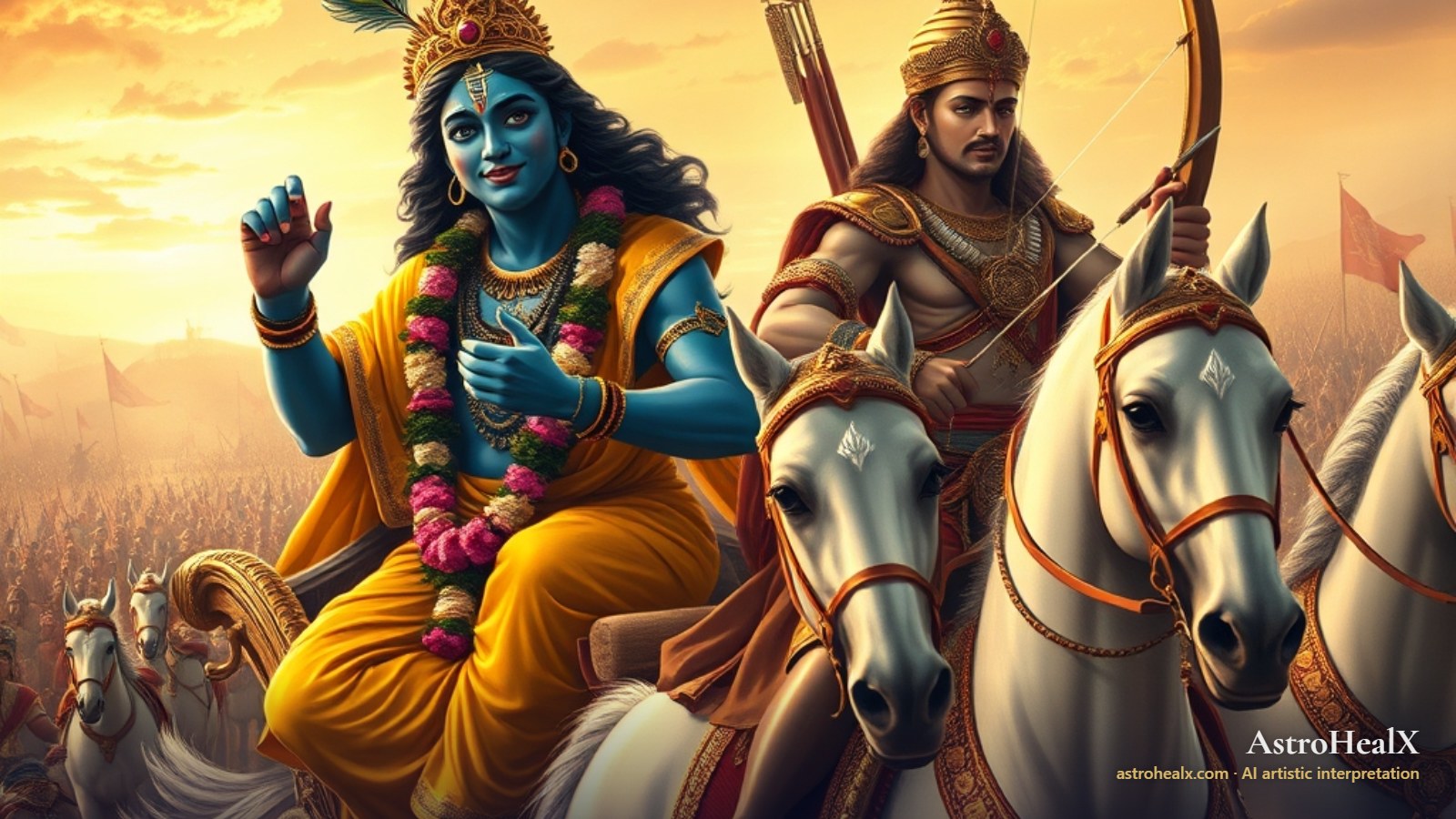
A hundred thousand verses. Eighteen books. One family in which every member tries to do right and the result is a war that empties the earth of its warriors. The Mahabharata is the longest poem ever composed and the most honest: nobody in it is only good, nobody is only bad, and the man who tells it — Vyasa — is the grandfather of both sides. At its centre, on a battlefield, a warrior lays down his bow and asks the question every reader eventually asks: why should I do this? The answer is the Bhagavad Gita.
Narrative follows Vyasa's Sanskrit Mahabharata (Critical Edition, Bhandarkar Oriental Research Institute, Pune, 1933–66; and the Vulgate as translated by K. M. Ganguli, 1883–96, public domain). Regional and later traditions — the Tamil Villiputturar Bharatam, Kannada Pampa Bharata, Bengali Kashiram Das, Jaimini Ashvamedha, and television retellings — are marked as variants wherever they are mentioned. Nothing here is a verse translation; all text is a modern retelling.
Adi Parva — Beginnings
- The Great Epic of the Mahabharata — A king who has just lost his father to a snake asks a storyteller: tell me what my ancestors did.
- Origins of the Kuru Dynasty — A king gives his youth to his son so that he can keep enjoying the world — and the son agrees.
- Shantanu, Ganga and Bhishma — A prince gives up the throne and then gives up marriage, and the gods cry out: 'Terrible! Terrible!'
- Birth of the Kauravas and Pandavas — One queen closes her eyes, one turns pale, and a maid does neither — and the kingdom's future is decided in three nights.
- Childhood Rivalries and Education — The cousins are children for only a few chapters, and already one of them is trying to kill another.
- Drona and the Training of the Princes — "What do you see?" — "The bird." — "Step back." — "The bird's head." — "Step back." — "Only the eye." — "Shoot."
- The House of Lac — A miner speaks in riddles, a mother and her five sons are found in the ashes, and the Pandavas are dead — officially.
- Draupadi's Swayamvara — "Look what we have brought home today, mother!" — "Share it among yourselves."
- The Founding of Indraprastha — Given a wasteland as his half of the kingdom, Yudhishthira builds a city on it that makes Hastinapura look old.
Sabha Parva — The Hall
- The Rajasuya Yajna — A hall of crystal floors that look like water, and a guest who walks into them — and is laughed at.
- The Game of Dice — "I stake my brother Arjuna." — "Won." — "I stake myself." — "Won." — "You still have one thing left to stake."
- Draupadi's Humiliation and the Vow — "Whom did you lose first — yourself, or me?"
Vana Parva — The Forest
- The Twelve Years of Forest Exile — A monkey's tail lies across the path, and the strongest man alive cannot move it.
Virata Parva — In Disguise
- The Year of Incognito — The greatest archer on earth spends a year teaching princesses to dance, in a braid and bangles.
Udyoga Parva — The Effort for Peace
- Krishna's Peace Mission — "Give them five villages." — "I will not give them land enough to hold the point of a needle."
Bhishma Parva — The Gita and the First Ten Days
- The Bhagavad Gita — Krishna's Teaching to Arjuna — The two armies are drawn up. The conches have sounded. And the best warrior on the field puts down his bow and says: I will not fight.
- The Kurukshetra War — Day by Day — Ten days, ten thousand dead a day, and the man killing them does not want to win.
- Bhishma's Fall — He lies on a bed of arrows with his head hanging, and asks the grandson who shot him for a pillow.
Drona, Karna & Shalya Parvas — The War
- Drona's Fall — "Ashwatthama is dead," says the man who cannot lie — and adds, under his breath, "the elephant."
- Karna's Story and Final Battle — The wheel sinks into the earth. He asks for a moment to lift it. The answer is a question: where was dharma when a boy was killed by six men?
- Duryodhana's Defeat — "Which of you will fight me? One at a time, I will kill you all." — "Choose any one of us. Beat him, and the kingdom is yours."
Sauptika & Stri Parvas — The Night and the Women
- Aftermath of the War — An owl kills a tree full of sleeping crows, and a man watching decides that this is how wars end.
Shanti & Anushasana Parvas — Peace and Instruction
- Yudhishthira's Coronation and Bhishma's Teaching — The victor sits down in the ashes and says he would rather beg than rule what he has won this way.
Ashvamedhika to Mausala Parvas — Later Years
- The Ashvamedha and the Later Years — A mongoose with half its body gold rolls on the ground at the emperor's sacrifice, and says it is not enough.
Mahaprasthanika & Svargarohana Parvas — The Ascent
- The Final Journey of the Pandavas — One by one they fall on the mountain, and the eldest tells the others exactly why, and does not look back.
- The End of the Earthly Journey and the Deeper Meaning — "Where my brothers are, that is heaven. This is not heaven."
हिंदी में
एक लाख श्लोक। अठारह पर्व। एक परिवार जिसका हर सदस्य सही करने का प्रयास करता है और परिणाम ऐसा युद्ध है जो पृथ्वी को योद्धाओं से रीता कर देता है। महाभारत कभी रचा गया सबसे लंबा काव्य है और सबसे ईमानदार: इसमें कोई केवल अच्छा नहीं, कोई केवल बुरा नहीं, और जो इसे कहता है — व्यास — दोनों पक्षों का पितामह है। इसके केंद्र में, रणभूमि पर, एक योद्धा धनुष रख देता है और वह प्रश्न पूछता है जो हर पाठक अंततः पूछता है: मैं यह क्यों करूँ? उत्तर भगवद्गीता है।
This page is the readable version. The interactive view has the full reader, search and related tools.
Open in AstroHealX