Mahabharata · Episode 5: Childhood Rivalries and Education
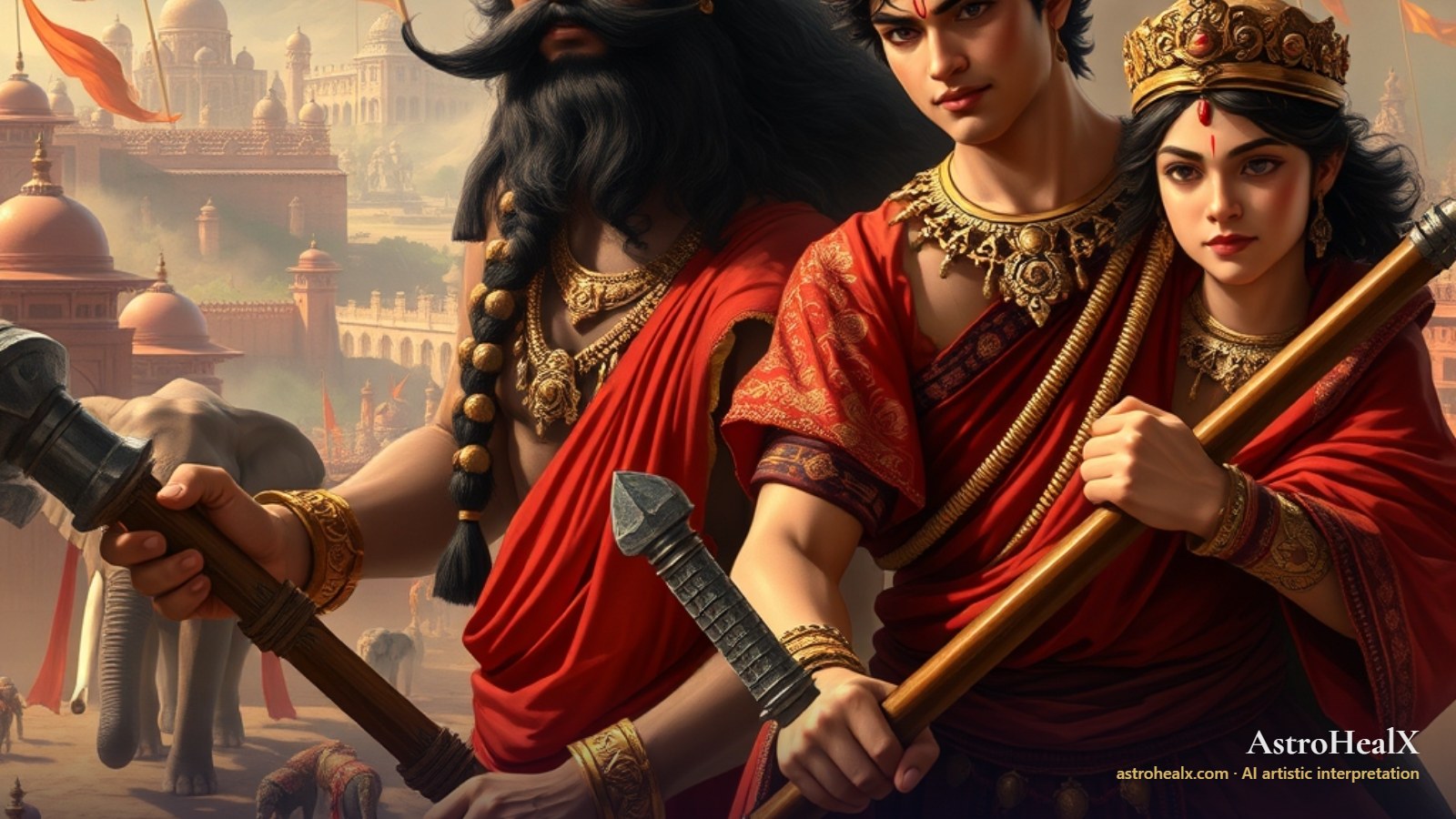
The cousins are children for only a few chapters, and already one of them is trying to kill another. · 10 min · 4 scenes
Scene 1
Bhima is the problem. In the games he grabs ten Kauravas at once and holds them under water until they half drown; he shakes trees till the boys fall out like fruit; he eats more than all hundred together. It is boyish and it is humiliating, and the poem is careful to say he means no harm. Duryodhana means harm. He reasons like an adult: Pandu's sons are strong and the eldest is the eldest; if Bhima is gone, the other four can be dealt with; then Yudhishthira's claim dies with him.
Scene 2
At a water-sports festival at Pramanakoti on the Ganga, Duryodhana feeds Bhima poisoned food with his own hands, waits until he sleeps, binds him with creepers and rolls him into the river. Bhima sinks into the realm of the Nagas, whose snakes bite him — and their venom cancels the poison. His great-grandfather among the serpents, Aryaka, recognises him; Vasuki, king of snakes, gives him the strength of a thousand elephants to drink. He comes home on the eighth day. Kunti and Vidura tell him to say nothing: in a house like this, knowing is safer than accusing.
Scene 3
Bhishma, meanwhile, educates. The princes learn the Vedas and the law; their first weapons teacher is Kripa, a foundling raised at court whose twin sister Kripi will marry the next teacher. Bhishma also teaches by example — the boys watch an old man of unbending word rule as regent for a blind king, and each learns something different from it: Yudhishthira that a promise is sacred, Duryodhana that an elder who has sworn obedience to the throne will never actually stop him.
Scene 4
A poor brahmin's son with a grudge is walking towards Hastinapura. Drona — 'born in a pot', son of the sage Bharadvaja — grew up with Prince Drupada of Panchala as his dearest friend, and Drupada promised to share his kingdom one day. Drona married Kripi; their son Ashwatthama was so poor he had never tasted milk and the other children fed him rice-water and laughed. Drona went to Drupada, now king, and reminded him. Drupada said: friendship is between equals; a beggar is no friend of a king; take some food and go. Drona went — to the Kurus, with his wife, his son, and the Brahma-weapon he had learned from Parashurama, and one purpose.
What happened
Bhima's strength humiliates the Kauravas; Duryodhana poisons him and throws him in the Ganga, where the Nagas save him; the princes learn from Bhishma and Kripa; Drona, insulted by his old friend King Drupada, sets out for Hastinapura with a grievance.
Why it matters
The war begins in the nursery. And the teacher who will shape every warrior in it arrives already carrying the wound — Drupada's insult — that will decide whom he teaches and what he asks in payment.
What happens next
A ball falls into a well, a bird's eye is the only thing one student sees, and a tribal boy learns archery from a clay statue.
Kunti and Vidura told Bhima to stay silent about the poisoning. Would speaking up have prevented the war — or started it twenty years early?
हिंदी में — बाल्यकाल की स्पर्धा और शिक्षा
भीम समस्या है। खेलों में वह दस कौरवों को एक साथ पकड़कर पानी में तब तक डुबाए रखता है जब तक वे अधमरे न हो जाएँ; वृक्ष हिलाता है कि लड़के फल-से गिरें; वह सौ के बराबर खाता है। यह बालपन है और अपमानजनक, और काव्य सावधानी से कहता है कि उसका आशय बुरा नहीं। दुर्योधन का आशय बुरा है। वह वयस्क की तरह तर्क करता है: पांडु के पुत्र बलवान हैं और ज्येष्ठ ज्येष्ठ है; भीम न रहे तो बाकी चार से निपटा जा सकता है; तब युधिष्ठिर का दावा उसके साथ मरेगा।
गंगा-तट प्रमाणकोटि के जल-क्रीड़ा उत्सव में दुर्योधन अपने हाथों भीम को विषयुक्त भोजन कराता है, सोने की प्रतीक्षा करता है, लताओं से बाँधकर नदी में ढकेलता है। भीम नागलोक में डूबता है, जहाँ सर्प उसे डसते हैं — और उनका विष विष को काट देता है। सर्पों में उसका प्रपितामह आर्यक उसे पहचानता है; नागराज वासुकि उसे सहस्र हाथियों का बल पिलाते हैं। वह आठवें दिन घर आता है। कुंती-विदुर कहते हैं कुछ न कहो: ऐसे घर में जानना आरोप लगाने से सुरक्षित है।
भीम का बल कौरवों को अपमानित करता है; दुर्योधन उसे विष देकर गंगा में फेंकता है, नाग बचाते हैं; राजकुमार भीष्म-कृप से सीखते हैं; पुराने मित्र राजा द्रुपद से अपमानित द्रोण एक गाँठ लिए हस्तिनापुर चलते हैं।
Sources: Mahabharata, Adi Parva, Sambhava sub-parva (1.119–1.122; 1.129–1.130). Modern retelling, not translation; "variant" marks regional or later additions. Images are AI artistic interpretations.
‹ Episode 4: Birth of the Kauravas and Pandavas · Episode 6: Drona and the Training of the Princes ›
This page is the readable version. The interactive view has the full reader, search and related tools.
Open in AstroHealX