Mahabharata · Episode 1: The Great Epic of the Mahabharata
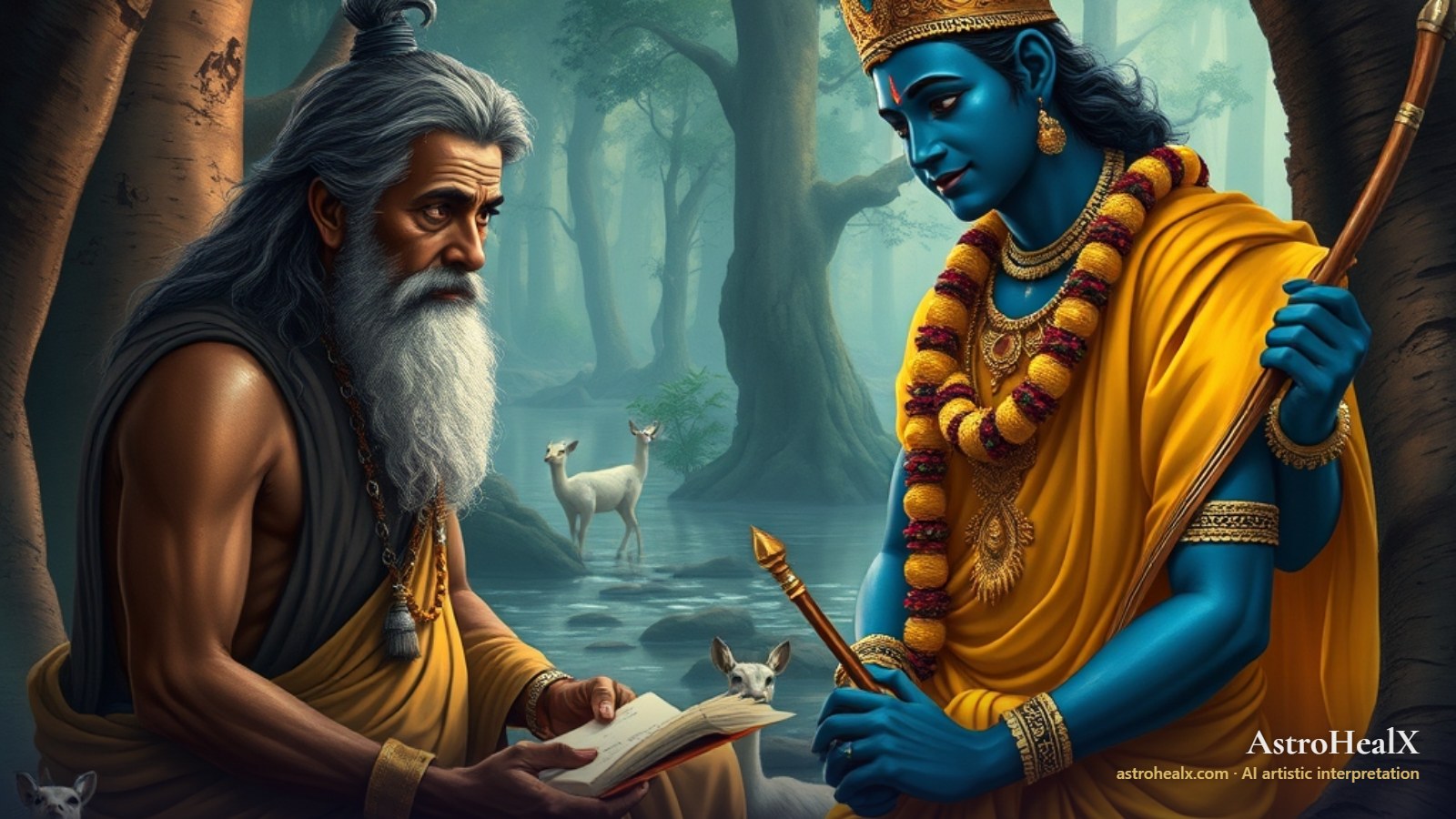
A king who has just lost his father to a snake asks a storyteller: tell me what my ancestors did. · 9 min · 5 scenes
Scene 1
The Mahabharata is a story inside a story inside a story. The outermost frame: in the Naimisha forest, the bard Ugrashravas arrives at a twelve-year sacrifice and the sages ask him for a tale. He has just come from the snake-sacrifice of King Janamejaya, where he heard Vaishampayana, a disciple of Vyasa, recite the poem Vyasa composed. So the sages hear from the bard what the bard heard from the disciple who heard it from the poet — who was himself inside the story as the grandfather of its heroes.
Scene 2
Vyasa — 'the Arranger', also called Krishna Dvaipayana, 'the dark one born on an island' — composed it, the poem says, over three years, and needed a scribe. Brahma suggested Ganesha, who agreed on one condition: his pen must never stop. Vyasa made his own condition: Ganesha must understand every verse before writing it. So whenever Vyasa needed to think, he composed a knot — a verse so difficult that the elephant-headed god paused to untangle it. Eight thousand eight hundred such knots, the tradition says, are still in the text. This story appears in some manuscripts and not in the critical edition; it is how India has always explained why the poem is so hard and so long.
Scene 3
The poem's own description of itself: 'What is here may be found elsewhere; what is not here is nowhere.' It is eighteen parvas — books — from the Adi (beginnings) to the Svargarohana (ascent to heaven), with the Harivamsha as an appendix. Inside it are the Bhagavad Gita, the story of Nala and Damayanti, the story of Savitri, the Shakuntala that Kalidasa later made a play, a thousand names of Vishnu, and whole treatises on kingship and liberation. It calls itself itihasa — 'thus indeed it was' — and also the fifth Veda, open to everyone.
Scene 4
What is it about? A family, the Kurus of Hastinapura, in which two sets of cousins — five Pandavas and a hundred Kauravas — cannot share a kingdom, and the elders who could have stopped them keep their promises instead. It is about dharma: the word means duty, law, nature, right — and the poem's deepest claim is that dharma is subtle, that in a hard case the right thing is never obvious, and that the gods themselves must come down and argue about it. The war lasts eighteen days. Everything leads to it and everything flows from it.
Scene 5
How this telling works. We follow the Sanskrit poem's order, parva by parva, and say plainly when a familiar story — the lac-house tunnel, Barbarika, Ekalavya's thumb, Karna's armour — is in the main text, in a regional retelling, or in television. Each episode ends with what happened, why it matters, what comes next, and a question. The art you see is an AI-assisted artistic interpretation, not a historical record. And when the poem itself doubts its heroes — which it does, constantly — we let it.
What happened
The frame: a bard tells sages what he heard at Janamejaya's snake-sacrifice; Vyasa composes and Ganesha writes; the poem's eighteen books, its claim that 'what is not here is nowhere', and its central question — what is dharma?
Why it matters
Knowing the frames explains the poem's texture — a story told three times over by people who were part of it — and knowing that dharma is 'subtle' prepares you for an epic that will refuse to make its villains simple.
What happens next
A king named for the moon, a cursed hunter, and a girl who smells of fish: the ancestors who make the Kurus.
The poet is the grandfather of both sides. Can someone that close to a war tell it fairly — or only someone that close?
हिंदी में — महाभारत — महाकाव्य का परिचय
महाभारत कथा के भीतर कथा के भीतर कथा है। सबसे बाहरी चौखट: नैमिषारण्य में सूत उग्रश्रवा बारह वर्ष के यज्ञ में आते हैं और ऋषि कथा माँगते हैं। वे अभी राजा जनमेजय के सर्प-यज्ञ से आए हैं, जहाँ उन्होंने व्यास के शिष्य वैशंपायन से वह काव्य सुना जो व्यास ने रचा। तो ऋषि सूत से सुनते हैं जो सूत ने उस शिष्य से सुना जिसने कवि से सुना — जो स्वयं कथा के भीतर नायकों के पितामह थे।
व्यास — 'व्यवस्था करने वाले', कृष्ण द्वैपायन भी, 'द्वीप पर जन्मे श्याम' — ने इसे, काव्य कहता है, तीन वर्ष में रचा, और लिपिक चाहिए था। ब्रह्मा ने गणेश सुझाए, जो एक शर्त पर माने: उनकी लेखनी कभी न रुके। व्यास ने अपनी शर्त रखी: गणेश हर श्लोक लिखने से पहले समझें। तो जब भी व्यास को सोचना होता, वे एक ग्रंथि रचते — ऐसा कठिन श्लोक कि गजानन उसे सुलझाने ठहरते। आठ हज़ार आठ सौ ऐसी ग्रंथियाँ, परंपरा कहती है, अब भी पाठ में हैं। यह कथा कुछ पांडुलिपियों में है, आलोचनात्मक संस्करण में नहीं; भारत ने सदा इसी से बताया है कि काव्य इतना कठिन और लंबा क्यों है।
चौखट: एक सूत ऋषियों को वह सुनाता है जो उसने जनमेजय के सर्प-यज्ञ में सुना; व्यास रचते हैं, गणेश लिखते हैं; काव्य के अठारह पर्व, 'जो यहाँ नहीं वह कहीं नहीं' का दावा, और केंद्रीय प्रश्न — धर्म क्या है?
Sources: Mahabharata, Adi Parva, Anukramanika & Parvasangraha (1.1–1.2) · Ganesha as scribe: northern manuscripts; not in the BORI critical edition (variant). Modern retelling, not translation; "variant" marks regional or later additions. Images are AI artistic interpretations.
Episode 2: Origins of the Kuru Dynasty ›
This page is the readable version. The interactive view has the full reader, search and related tools.
Open in AstroHealX