Mahabharata · Episode 4: Birth of the Kauravas and Pandavas
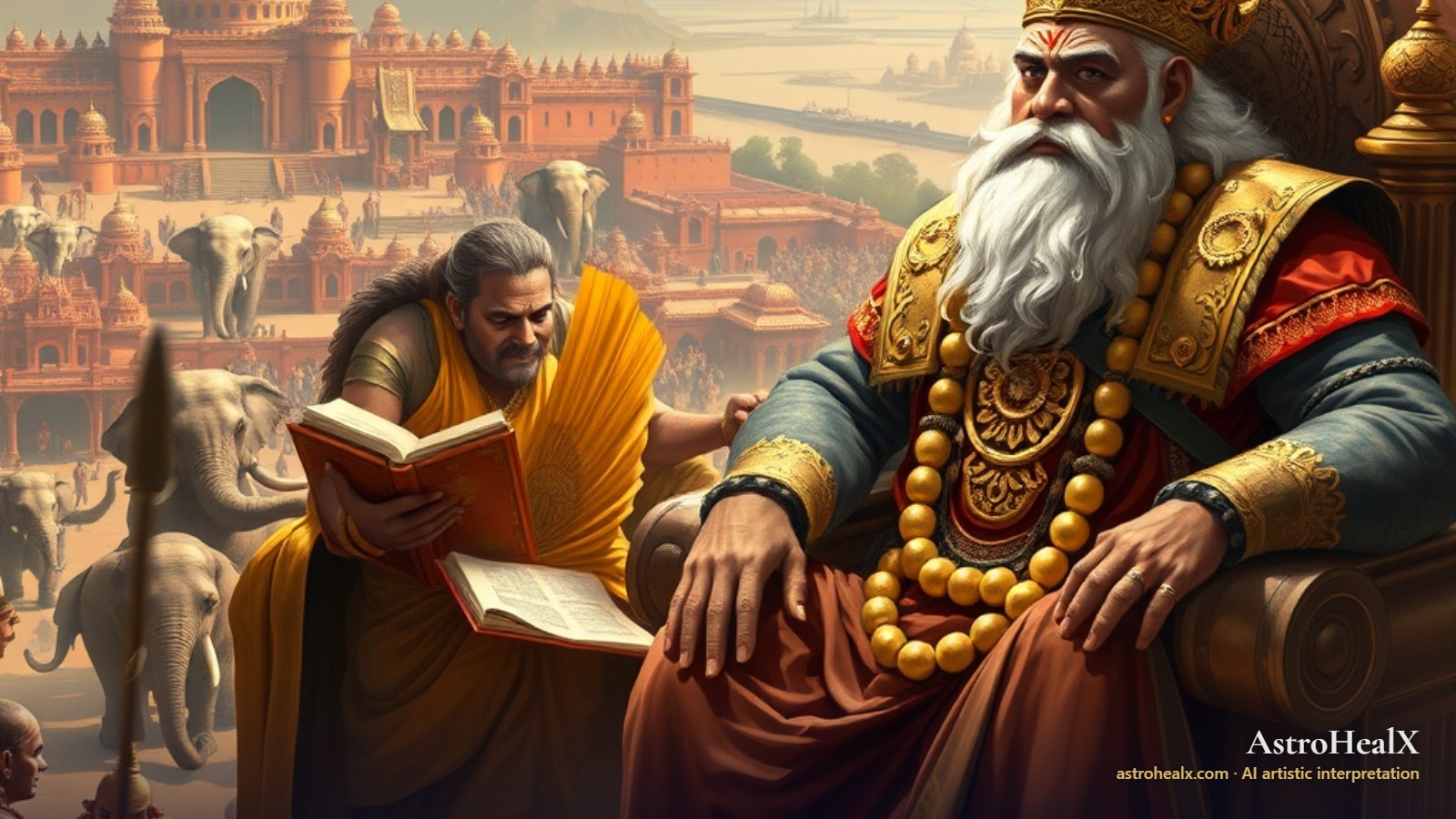
One queen closes her eyes, one turns pale, and a maid does neither — and the kingdom's future is decided in three nights. · 12 min · 7 scenes
Scene 1
Vyasa agrees to father sons on the widows, but warns that they must bear his ugliness and smell. Ambika shuts her eyes through the night; her son is born blind — Dhritarashtra. Ambalika goes pale; her son is born pale and sickly — Pandu. Asked a third time, Ambika sends her maid in her place, who receives the sage with calm and respect; her son is born perfect — Vidura, who is Dharma himself incarnate, cursed to be born of a servant, and who because of his mother can never be king. The blind one is the eldest; the law bars him; the throne goes to Pandu, with Bhishma as his guardian and Vidura as his minister.
Scene 2
Bhishma arranges marriages. For Dhritarashtra, Gandhari of Gandhara, who on learning her husband is blind binds her own eyes with a cloth and never removes it; her brother Shakuni comes with her to Hastinapura and stays. For Pandu, Kunti — born Pritha, daughter of the Yadava Shura, adopted by Kuntibhoja — who wins him at her swayamvara, and then a second wife, Madri of Madra, bought from her brother Shalya for gold, as that country's custom was. Pandu goes out and conquers; he brings back wealth enough that the kingdom is rich for a generation. Then he goes hunting.
Scene 3
In the forest Pandu shoots a pair of deer mating; the stag is the sage Kindama in animal form, and dying he curses the king: the moment you embrace a woman in desire, you will die. Pandu gives up the kingdom to Dhritarashtra, renounces everything and goes to live as an ascetic in the Himalaya with both wives. There, longing for sons, he remembers the law of niyoga and asks Kunti to bear children by another. Kunti tells him a secret of her own. As a girl she served the irascible sage Durvasa so well that he taught her a mantra: call any god and he will come and give you a son. She has used it once already.
Scene 4
Curious, as a girl, she had tested it on the Sun. Surya came, and would not be sent away, and she bore a son with golden armour and earrings grown into his skin — and, terrified of disgrace, she put the baby in a box and set it on the river. A charioteer of Hastinapura, Adhiratha, and his wife Radha found it and raised him as their own: Vasushena, later Karna, the charioteer's son. Kunti tells Pandu none of this. The poem tells us, so that we will know, every time Karna is mocked for his birth, who is standing silent in the room.
Scene 5
With Pandu's blessing Kunti calls three gods. Dharma gives Yudhishthira, who will never lie. Vayu, the Wind, gives Bhima, who falls from his mother's lap as an infant and shatters the rock beneath. Indra, after a year of Pandu's austerities, gives Arjuna, at whose birth a voice promises he will equal Shiva and Vishnu in battle. Pandu asks for more; Kunti refuses — 'the law does not allow a fourth' — but lends the mantra once to Madri, who cleverly calls the twin Ashvins and gets two sons, Nakula and Sahadeva. Kunti never forgives the trick. The five are the Pandavas — the sons of Pandu who are not Pandu's sons.
Scene 6
Meanwhile in Hastinapura Gandhari, granted a hundred sons by Vyasa, has been pregnant for two years. Hearing that Kunti has borne a son first, she strikes her own belly in frustration and delivers a hard ball of flesh. Vyasa divides it into a hundred and one pieces and sets them in jars of ghee; in a year they hatch — a hundred sons and a daughter, Dushala. The firstborn, Duryodhana, brays like a donkey at birth, and donkeys, jackals and crows answer across the city. Vidura tells the king: this child will destroy the family; abandon him. Dhritarashtra, who cannot see the omens, cannot bring himself to.
Scene 7
One spring day in the mountains Pandu, seeing Madri alone in thin clothes, forgets the curse and reaches for her, and dies in her arms. Madri, blaming herself, insists on following him onto the pyre and asks Kunti to raise her twins as her own. The sages of the forest bring Kunti and five boys aged between five and twelve down to Hastinapura and present them at the gate: these are Pandu's sons. Bhishma and Vidura accept them at once. Dhritarashtra accepts them because he must. Duryodhana, aged about twelve, watches five strangers arrive to share his inheritance.
What happened
Vyasa fathers Dhritarashtra (blind), Pandu (pale) and Vidura (by the maid); Pandu is cursed by Kindama and retires; Kunti's mantra — already used once to bear Karna, abandoned on the river — gives Yudhishthira, Bhima and Arjuna, and Madri's use gives the twins; Gandhari bears a hundred sons from a ball of flesh; Pandu dies and the Pandavas come to Hastinapura.
Why it matters
Every birth here is irregular, and the epic says so without embarrassment. Nobody on either side has a straightforward claim to the throne — which is precisely why the argument over it can never be settled by law alone.
What happens next
A boy who can out-eat and out-wrestle a hundred cousins is poisoned and thrown in the river; and a teacher arrives at the palace by retrieving a ball from a well with blades of grass.
Kunti kept Karna's existence secret for sixty years. Was that cowardice, protection — or the one choice that made the whole war possible?
हिंदी में — कौरवों और पांडवों का जन्म
व्यास विधवाओं से पुत्र उत्पन्न करने को मानते हैं, पर चेताते हैं कि उन्हें उनकी कुरूपता और गंध सहनी होगी। अंबिका रातभर आँखें मूँदे रहती है; पुत्र अंधा जन्मता है — धृतराष्ट्र। अंबालिका पीली पड़ती है; पुत्र पीला और रुग्ण — पांडु। तीसरी बार कहे जाने पर अंबिका अपनी दासी भेजती है, जो ऋषि को शांति और आदर से ग्रहण करती है; पुत्र पूर्ण जन्मता है — विदुर, स्वयं धर्म का अवतार, दासी-जन्म के शाप वाला, जो माता के कारण कभी राजा नहीं हो सकता। अंधा ज्येष्ठ है; विधि रोकती है; राज्य पांडु को मिलता है, भीष्म संरक्षक, विदुर मंत्री।
भीष्म विवाह तय करते हैं। धृतराष्ट्र के लिए गांधार की गांधारी, जो पति के अंधे होने की सूचना पर अपनी आँखों पर पट्टी बाँधती है और कभी नहीं खोलती; उसका भाई शकुनि साथ हस्तिनापुर आता है और रह जाता है। पांडु के लिए कुंती — जन्म से पृथा, यादव शूर की पुत्री, कुंतिभोज द्वारा दत्तक — जो स्वयंवर में उन्हें चुनती है, और फिर दूसरी पत्नी मद्र की माद्री, भाई शल्य से उस देश की प्रथा के अनुसार स्वर्ण देकर लाई। पांडु विजय-यात्रा पर जाते हैं; इतना धन लाते हैं कि राज्य पीढ़ीभर समृद्ध रहता है। फिर शिकार पर जाते हैं।
व्यास से धृतराष्ट्र (अंधे), पांडु (पीले), विदुर (दासी से) जन्मते हैं; पांडु किंदम से शापित होकर वन जाते हैं; कुंती का मंत्र — पहले एक बार कर्ण के लिए प्रयुक्त, जिसे नदी में छोड़ा — युधिष्ठिर, भीम, अर्जुन देता है, माद्री का प्रयोग युगल देता है; गांधारी माँस-पिंड से सौ पुत्र जन्मती है; पांडु मरते हैं और पांडव हस्तिनापुर आते हैं।
Sources: Mahabharata, Adi Parva, Sambhava sub-parva (1.100–1.117). Modern retelling, not translation; "variant" marks regional or later additions. Images are AI artistic interpretations.
‹ Episode 3: Shantanu, Ganga and Bhishma · Episode 5: Childhood Rivalries and Education ›
This page is the readable version. The interactive view has the full reader, search and related tools.
Open in AstroHealX