Mahabharata · Episode 2: Origins of the Kuru Dynasty
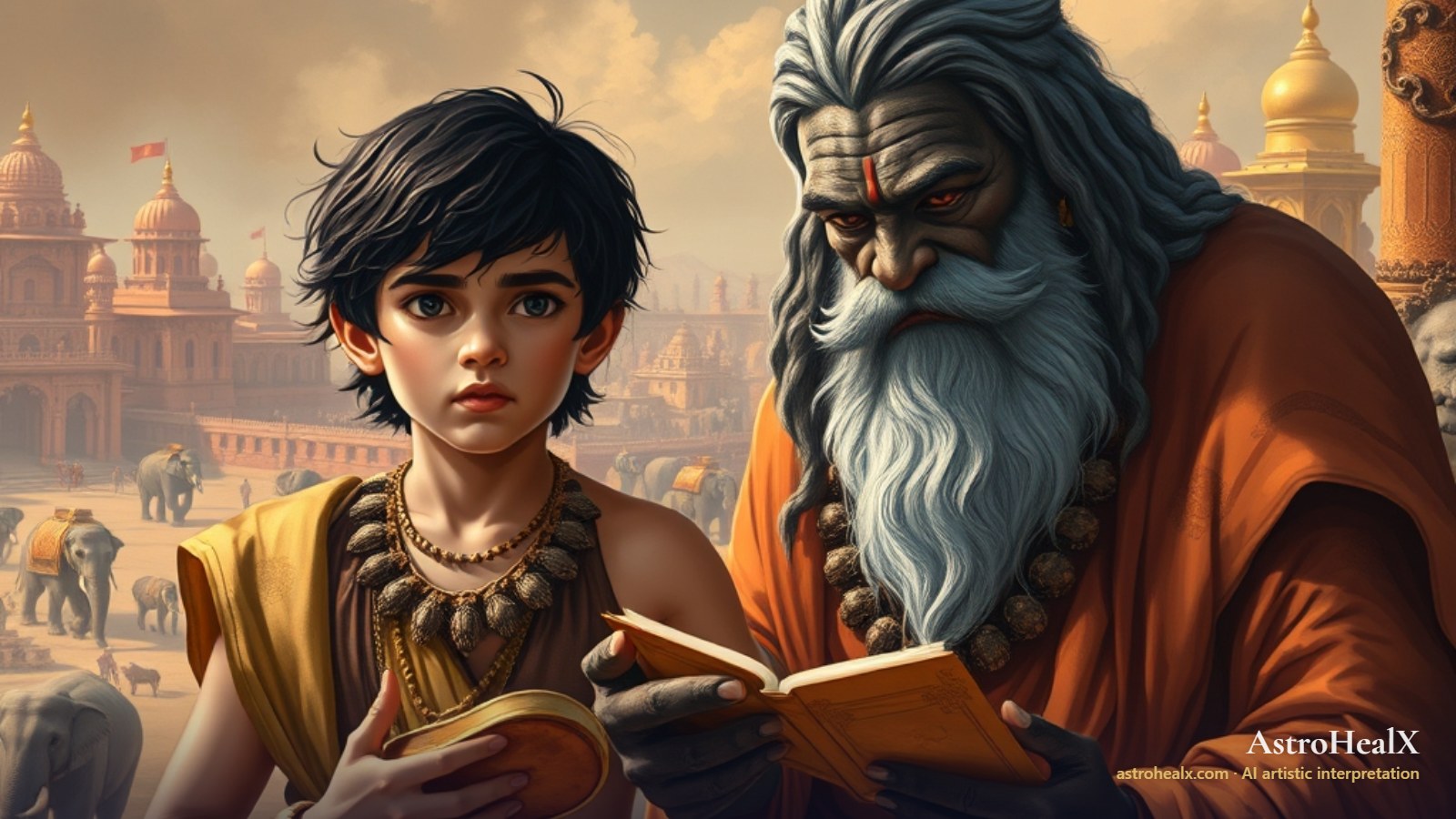
A king gives his youth to his son so that he can keep enjoying the world — and the son agrees. · 10 min · 5 scenes
Scene 1
The line begins with the Moon. His descendant Pururavas loved the nymph Urvashi, lost her by breaking a condition, and won her back — the oldest love story in Sanskrit, already in the Rigveda. His line produced Nahusha, who was made king of heaven when Indra fled and lost it when he made the seven sages carry his palanquin and kicked Agastya for being slow; he fell to earth as a serpent and will wait ten thousand years to meet Yudhishthira. The poem's ancestors are never only glorious.
Scene 2
Nahusha's son Yayati married Devayani, daughter of the sage Shukra, and also secretly loved her maid Sharmishtha, a princess reduced to servitude by a quarrel over a garment at a well. Shukra cursed him with old age. Yayati asked each of his five sons to take the curse for a thousand years; four refused and were cursed in turn; the youngest, Puru, agreed. Yayati enjoyed his son's youth for a thousand years and learned what the poem wants us to learn: 'Desire is never quenched by enjoyment, as fire is not quenched by ghee.' He gave the youth back and the kingdom to Puru. The Pauravas — and so the Kurus — descend from the son who said yes.
Scene 3
Generations later King Dushyanta, hunting, finds Shakuntala — daughter of the sage Vishwamitra and the nymph Menaka, abandoned at birth and raised by Kanva — and marries her by the gandharva rite, promising her son the throne. He goes home and forgets. Years later she arrives at court with a boy, and in the poem Dushyanta denies her publicly, until a voice from the sky confirms the child is his. (Kalidasa's play adds the ring and the curse of forgetting — the version most people know.) The boy is Bharata, and the land is named after him: Bharatavarsha.
Scene 4
Bharata's descendant Hastin founds Hastinapura — 'elephant city' — on the Ganga. His descendant Kuru performs such austerities on a field north of Delhi that it is named Kurukshetra and anyone who dies there goes to heaven; the war will be fought on it for exactly that reason. From Kuru the line runs down to Pratipa, whose son Shantanu is where the story most people know begins.
Scene 5
One more ancestor, outside the royal line: on a ferry across the Yamuna, the sage Parashara sees the ferryman's daughter Satyavati, who was born of a fish and smells of fish, and desires her. He wraps the river in fog, grants her that her virginity be restored and her smell become fragrance, and leaves her with a son born on an island, dark-skinned, who grows up at once and goes away to the forest promising to come when she calls. The son is Vyasa. Satyavati will go on to marry a king and become grandmother of the Kurus — and when the royal line fails, she will call her first son.
What happened
The lunar line from Pururavas through Nahusha and Yayati (who borrowed his son's youth) to Dushyanta and Shakuntala's son Bharata, Hastin, Kuru and Kurukshetra; and Satyavati's secret first son, Vyasa.
Why it matters
Every theme of the epic is already here in miniature: a father's demand on a son (Yayati), a husband's broken word (Dushyanta), a child born outside marriage who will matter more than the heirs (Vyasa).
What happens next
Shantanu marries a river and loses seven sons to it. The eighth will take the most terrible vow in the epic.
Puru gave his father a thousand years of his youth and was rewarded with the kingdom. Was it love, obedience, or the shrewdest move in the family?
हिंदी में — कुरुवंश का उद्गम
वंश चंद्र से आरंभ होता है। उनके वंशज पुरूरवा ने अप्सरा उर्वशी को प्रेम किया, एक शर्त तोड़कर खोया, और फिर पाया — संस्कृत की प्राचीनतम प्रेम-कथा, ऋग्वेद में ही। उनके वंश में नहुष हुए, जो इंद्र के भागने पर स्वर्ग के राजा बने और सप्तर्षियों को पालकी उठवाकर, धीमे चलने पर अगस्त्य को लात मारकर पद खोया; सर्प बनकर पृथ्वी पर गिरे और युधिष्ठिर से मिलने दस हज़ार वर्ष प्रतीक्षा करेंगे। काव्य के पूर्वज कभी केवल गौरवशाली नहीं होते।
नहुष-पुत्र ययाति ने शुक्राचार्य की पुत्री देवयानी से विवाह किया, और गुप्त रूप से उनकी दासी शर्मिष्ठा को भी चाहा, जो कूप पर वस्त्र के झगड़े से दासी बनी राजकुमारी थी। शुक्र ने वृद्धावस्था का शाप दिया। ययाति ने पाँच पुत्रों से हज़ार वर्ष शाप लेने को कहा; चार ने मना किया और शापित हुए; सबसे छोटे पुरु ने माना। ययाति ने हज़ार वर्ष पुत्र का यौवन भोगा और वह सीखा जो काव्य हमें सिखाना चाहता है: 'भोग से कामना शांत नहीं होती, जैसे घी से अग्नि।' उन्होंने यौवन और राज्य पुरु को लौटाया। पौरव — और इस प्रकार कुरु — उस पुत्र से हैं जिसने हाँ कहा।
पुरूरवा से नहुष, ययाति (जिसने पुत्र का यौवन लिया) होते हुए दुष्यंत-शकुंतला के पुत्र भरत, हस्तिन, कुरु और कुरुक्षेत्र तक चंद्रवंश; और सत्यवती का गुप्त प्रथम पुत्र, व्यास।
Sources: Mahabharata, Adi Parva, Sambhava sub-parva (1.70–1.94) · Kalidasa, Abhijnanashakuntalam (variant with ring and curse). Modern retelling, not translation; "variant" marks regional or later additions. Images are AI artistic interpretations.
‹ Episode 1: The Great Epic of the Mahabharata · Episode 3: Shantanu, Ganga and Bhishma ›
This page is the readable version. The interactive view has the full reader, search and related tools.
Open in AstroHealX