Mahabharata · Episode 3: Shantanu, Ganga and Bhishma
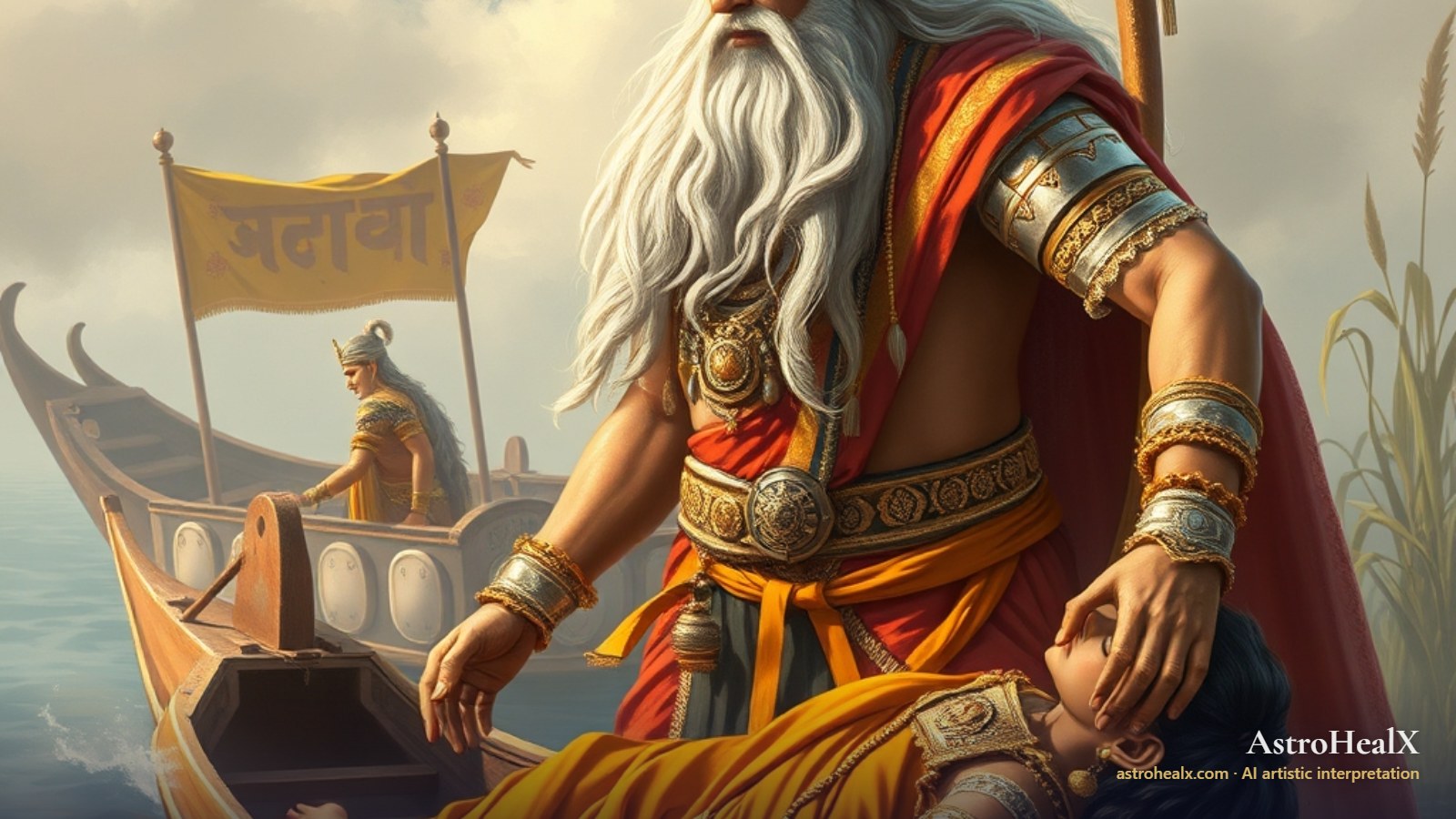
A prince gives up the throne and then gives up marriage, and the gods cry out: 'Terrible! Terrible!' · 11 min · 5 scenes
Scene 1
King Shantanu, hunting along the Ganga, meets a woman of unearthly beauty and asks her to marry him. She agrees on a condition: he must never question anything she does, or she will leave. Seven sons are born and she drowns each in the river at birth; Shantanu, bound by his word, says nothing. At the eighth he breaks: "Who are you? Why?" She tells him. She is the river Ganga; the children were the eight Vasus, gods cursed to be born human, who begged her to end their lives quickly; this eighth one, Dyaus, must live out a long human life as his punishment. She takes the child away to raise him, and leaves.
Scene 2
Years later Shantanu, by the river, sees the water held back by a wall of arrows and a boy shooting them. Ganga appears and gives him his son, Devavrata, taught the Vedas by Vasishtha, arms by Parashurama, and statecraft by Brihaspati. Shantanu takes him home and makes him heir, and for four years the kingdom is as happy as it will ever be.
Scene 3
Then Shantanu, by the Yamuna, smells a fragrance and finds its source: Satyavati, the fisher-chief's daughter. He asks for her. Her father sets a price — her son must be king. Shantanu, who has already named an heir, refuses and goes home sick with longing. Devavrata finds out why his father is wasting, goes to the fisherman himself, and gives up the throne for Satyavati's sons. Not enough, says the fisherman: your sons will fight hers. So the prince raises his hand and swears he will never marry, never father a child — brahmacharya for life. The gods rain flowers and cry 'Bhishma!' — 'he of the terrible vow' — and that is his name from then on. Shantanu, grateful, grants him death only when he himself chooses it.
Scene 4
Satyavati bears two sons. Chitrangada, the elder, is killed in a three-year duel by a gandharva of the same name who objects to sharing it. Vichitravirya, the younger, is a boy when he becomes king, so Bhishma rules for him, and finds him wives by force: he rides to the swayamvara at Kashi, announces that carrying off a bride after defeating her suitors is the kshatriya's right, defeats every king present including Shalva, and brings back three princesses — Amba, Ambika and Ambalika. Amba says she had already chosen Shalva in her heart. Bhishma lets her go to him. Shalva refuses her as another man's prize. She returns to Bhishma and asks him to marry her; he cannot. Amba's rage will take her to Parashurama, to a lifetime of austerity, and finally to rebirth as a man — Shikhandi — who will stand before Bhishma on the tenth day of the war.
Scene 5
Vichitravirya enjoys seven years with his two wives and dies of consumption, childless. The line of Shantanu is at an end. Satyavati asks Bhishma to do what the law allows — beget sons on his brother's widows, or take the throne and marry. He refuses with a speech that defines him: "The earth may lose its fragrance, water its wetness, the sun its light — I will not abandon truth." Satyavati then tells him her secret: before her marriage she bore a sage's son, who promised to come when called. She calls. Vyasa comes out of the forest, smelling of the woods, matted and terrible to look at.
What happened
Ganga bears Shantanu eight sons and drowns seven; the eighth, Devavrata, gives up throne and marriage for his father's love of Satyavati and becomes Bhishma; he wins three brides for his half-brother, one of whom, Amba, will become his death; the line fails and Satyavati summons Vyasa.
Why it matters
Bhishma's vow is the epic's first great sacrifice and its first great error: made out of love for his father, it removes the one man who could have ruled, and leaves the throne to a blind man, a weakling and a regent bound by oath to whoever sits on it.
What happens next
Two widows, a maid and a terrifying sage: the births of Dhritarashtra, Pandu and Vidura — and, a generation on, of a hundred and five cousins.
Bhishma kept his vow for a hundred years while the kingdom fell apart around him. At what point does keeping a promise become a way of avoiding responsibility?
Wisdom from the epic — A vow and its shadow
Bhishma's vow was pure, and its consequences were catastrophic. Before binding yourself forever, ask not only 'is this noble?' but 'who will carry the weight of this besides me?'
हिंदी में — शांतनु, गंगा और भीष्म
गंगा-तट पर शिकार करते राजा शांतनु अलौकिक सुंदरी से मिलते हैं और विवाह का प्रस्ताव करते हैं। वह एक शर्त पर मानती है: वे उसके किसी कर्म पर प्रश्न न करें, वरना वह चली जाएगी। सात पुत्र जन्मते हैं और वह हर एक को जन्म पर नदी में डुबा देती है; वचनबद्ध शांतनु कुछ नहीं कहते। आठवें पर वे टूटते हैं: "तुम कौन हो? क्यों?" वह बताती है। वह गंगा है; संतानें आठ वसु थे, मानव-जन्म के शाप वाले देव, जिन्होंने शीघ्र मुक्ति माँगी; यह आठवाँ, द्यौ, दंड-रूप में लंबा मानव-जीवन जिएगा। वह शिशु को पालने ले जाती है, और चली जाती है।
वर्षों बाद नदी-तट पर शांतनु जल को बाणों की दीवार से रुका और एक बालक को बाण चलाते देखते हैं। गंगा प्रकट होकर पुत्र देवव्रत देती हैं, जिसे वसिष्ठ ने वेद, परशुराम ने अस्त्र और बृहस्पति ने राजनीति सिखाई। शांतनु उसे घर ले जाकर युवराज बनाते हैं, और चार वर्ष राज्य जितना सुखी हो सकता है उतना होता है।
गंगा शांतनु को आठ पुत्र देकर सात डुबाती हैं; आठवाँ देवव्रत पिता के सत्यवती-प्रेम के लिए राज्य और विवाह त्यागकर भीष्म बनता है; अर्ध-भ्राता के लिए तीन कन्याएँ जीतता है, जिनमें अंबा उसकी मृत्यु बनेगी; वंश टूटता है और सत्यवती व्यास को पुकारती हैं।
Sources: Mahabharata, Adi Parva, Sambhava sub-parva (1.91–1.100) · Amba's story: Udyoga Parva, Ambopakhyana (5.170–5.193). Modern retelling, not translation; "variant" marks regional or later additions. Images are AI artistic interpretations.
‹ Episode 2: Origins of the Kuru Dynasty · Episode 4: Birth of the Kauravas and Pandavas ›
This page is the readable version. The interactive view has the full reader, search and related tools.
Open in AstroHealX