Navratri & Durga Puja · नवरात्रि और दुर्गा पूजा
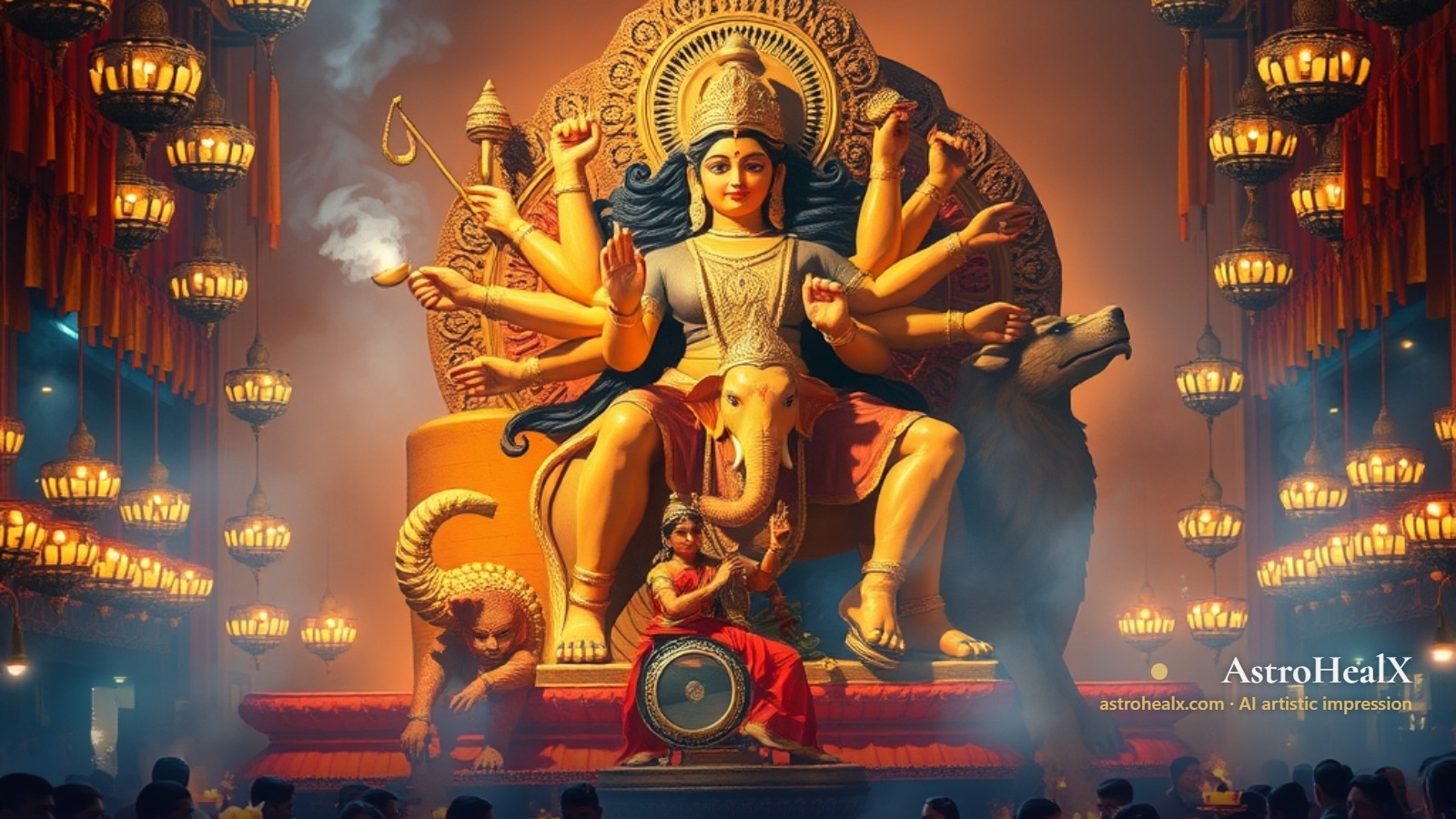
Nine nights of the Goddess: kalash sthapana, a form of Durga each day, fasting, garba in the west, the great clay images of Bengal — ending with Vijayadashami.
| When | Ashwin Shukla Pratipada to Navami, Vijayadashami on the tenth — 2026: 11–19 October, Dussehra 20 October (Bengal: Shashthi 16 Oct to Dashami 20 Oct). Chaitra Navratri 2026: 19–27 March, Ram Navami 27 March. |
|---|---|
| Deity | Durga in nine forms (Navadurga); in Bengal Durga Mahishasuramardini with Lakshmi, Saraswati, Ganesh and Kartikeya |
| Where | All India — Gujarat (garba), Bengal/Odisha/Assam (Durga Puja), north (Ramlila, kanya pujan), south (Golu dolls, Saraswati/Ayudha puja), Mysore Dasara |
Origin and scripture
The Devi Mahatmya (Durga Saptashati, Markandeya Purana ch. 81–93) is the text: the Goddess slays Madhu–Kaitabha, Mahishasura and Shumbha–Nishumbha. Rama is said to have worshipped Durga in autumn before marching on Lanka (akal bodhan, "untimely awakening" — the Bengali Krittivasa Ramayana), which is why Sharadiya Navratri outranks the spring one. The nine forms (Shailaputri to Siddhidatri) are from the Devi Kavacha.
The vidhi, step by step
- Day 1 — Ghatasthapana — In the morning muhurta (avoid Chitra nakshatra/Vaidhriti yoga per panchang), a clay tray is filled with soil and barley (jau) is sown; the kalash with water, supari, coin, durva, mango leaves and a coconut in red cloth is set on it; an akhand jyoti (unbroken lamp) is lit for nine days. Durga is invoked with the Saptashati's Devi Suktam. The sprouting barley (jawara) is read as the year's prosperity.
- Days 1–9 — the nine forms — Each day a form, a colour and an offering: Shailaputri (ghee), Brahmacharini (sugar), Chandraghanta (kheer), Kushmanda (malpua), Skandamata (banana), Katyayani (honey), Kalaratri (jaggery), Mahagauri (coconut), Siddhidatri (til/sesame). Daily: Durga Saptashati path (full, or one chapter, or the Siddha Kunjika stotra), aarti, and a fast — fruit, sabudana, kuttu, singhara, rock salt.
- Ashtami–Navami — Kanya pujan and havan — Nine girls (2–10 years, as the nine forms) and one boy (Bhairava/Langur) are invited; their feet are washed, mauli tied, tilak applied, and they are fed puri, halwa and chana and given a gift. A havan with the Saptashati or the Navarna mantra closes the vrat; in Bengal, Sandhi Puja at the junction of Ashtami and Navami with 108 lamps and 108 lotuses.
- Bengal's Durga Puja — Shashthi to Dashami — Bodhan (awakening the goddess in a bel tree) on Shashthi; Saptami begins with the Nabapatrika — nine plants bathed in the river as the goddess (the "Kola Bou"); Ashtami pushpanjali and Sandhi Puja; Navami homa; Dashami — the women's sindoor khela, the "Shanti jal", and the immersion with the drums (dhak) — "ashchhe bochhor abar hobe".
- Vijayadashami — The barley sprouts are cut and placed behind the ears / in caps as blessings; Shami tree and weapons/tools are worshipped (Ayudha puja); Ravana is burned in the north; in Mysore the goddess Chamundeshwari rides out. The day is held auspicious for beginning anything new — learning above all (Vidyarambha).
Samagri
- Kalash, clay tray, soil, barley seed, coconut in red chunri, mango leaves
- Akhand jyoti lamp with enough ghee/oil for nine days
- Durga image/idol, red chunri, bangles, sindoor, 16 shringar items
- Red flowers (hibiscus), lotus (Bengal), bel leaves, durva
- Durga Saptashati book; havan kund, samidha, ghee, havan samagri
- Daily bhog items for the nine forms; kanya pujan: puri, halwa, chana, gifts
- Fasting foods: sabudana, kuttu, singhara, fruit, rock salt
Mantras
Navarna mantra
ॐ ऐं ह्रीं क्लीं चामुण्डायै विच्चे
oṃ aiṃ hrīṃ klīṃ cāmuṇḍāyai vicce
The nine-syllable mantra of the Saptashati — Saraswati, Mahalakshmi and Mahakali in one. (Durga Saptashati tradition)
Devi Suktam / Saptashati 5.9 refrain
या देवी सर्वभूतेषु शक्तिरूपेण संस्थिता। नमस्तस्यै नमस्तस्यै नमस्तस्यै नमो नमः॥
yā devī sarvabhūteṣu śaktirūpeṇa saṃsthitā | namastasyai namastasyai namastasyai namo namaḥ ||
To the Goddess who abides in all beings as power — salutation to her, salutation, salutation, again and again. (Markandeya Purana, Devi Mahatmya 5)
Durga dhyana
सर्वमङ्गलमाङ्गल्ये शिवे सर्वार्थसाधिके। शरण्ये त्र्यम्बके गौरि नारायणि नमोऽस्तु ते॥
sarvamaṅgalamāṅgalye śive sarvārthasādhike | śaraṇye tryambake gauri nārāyaṇi namo'stu te ||
Auspiciousness of all that is auspicious, O Shiva, accomplisher of all aims, refuge, three-eyed Gauri, Narayani — salutation to you. (Devi Mahatmya 11.10)
Do
- Establish the kalash in the morning muhurta of Pratipada
- Keep the akhand jyoti safe — in a glass or on sand, away from cloth
- Feed and gift the kanyas with the same respect as the goddess
Don't
- No onion/garlic/meat/alcohol in the house for the nine days; no cutting hair or nails for the vrati
- Do not let the barley dry out or the lamp go out
- Do not immerse painted idols in rivers; use clay and natural colour
हिंदी में — नवरात्रि और दुर्गा पूजा
देवी की नौ रातें: कलश-स्थापना, प्रतिदिन दुर्गा का एक रूप, उपवास, पश्चिम में गरबा, बंगाल की विशाल मृण्मूर्तियाँ — विजयादशमी पर समापन।
देवी माहात्म्य (दुर्गा सप्तशती, मार्कंडेय पुराण अध्याय 81–93) मूल ग्रंथ: देवी मधु-कैटभ, महिषासुर और शुंभ-निशुंभ का वध करती हैं। राम ने लंका पर चढ़ाई से पहले शरद में दुर्गा की पूजा की (अकाल बोधन — बांग्ला कृत्तिवास रामायण), इसीलिए शारदीय नवरात्रि वासंती से ऊपर। नौ रूप (शैलपुत्री से सिद्धिदात्री) देवी कवच से।
दिन 1 — घटस्थापना — प्रातः मुहूर्त में (पंचांग के अनुसार चित्रा नक्षत्र/वैधृति योग टालकर) मिट्टी के पात्र में मिट्टी भरकर जौ बोए जाते हैं; उस पर जल, सुपारी, सिक्का, दूर्वा, आम-पत्ते और लाल वस्त्र में नारियल सहित कलश; नौ दिन अखंड ज्योति। सप्तशती के देवी सूक्त से दुर्गा का आवाहन। उगता जवारा वर्ष की समृद्धि का संकेत।
दिन 1–9 — नौ रूप — हर दिन एक रूप, एक रंग, एक भोग: शैलपुत्री (घी), ब्रह्मचारिणी (शक्कर), चंद्रघंटा (खीर), कूष्मांडा (मालपुआ), स्कंदमाता (केला), कात्यायनी (शहद), कालरात्रि (गुड़), महागौरी (नारियल), सिद्धिदात्री (तिल)। प्रतिदिन: दुर्गा सप्तशती पाठ (पूर्ण, एक अध्याय, या सिद्ध कुंजिका स्तोत्र), आरती, व्रत — फल, साबूदाना, कुट्टू, सिंघाड़ा, सेंधा नमक।
Sources: Markandeya Purana 81–93 (Devi Mahatmya / Durga Saptashati) · Devi Bhagavata Purana · Krittivasa Ramayana (akal bodhan). Family and regional custom take precedence.
This page is the readable version. The interactive view has the full reader, search and related tools.
Open in AstroHealX