Karwa Chauth · करवा चौथ
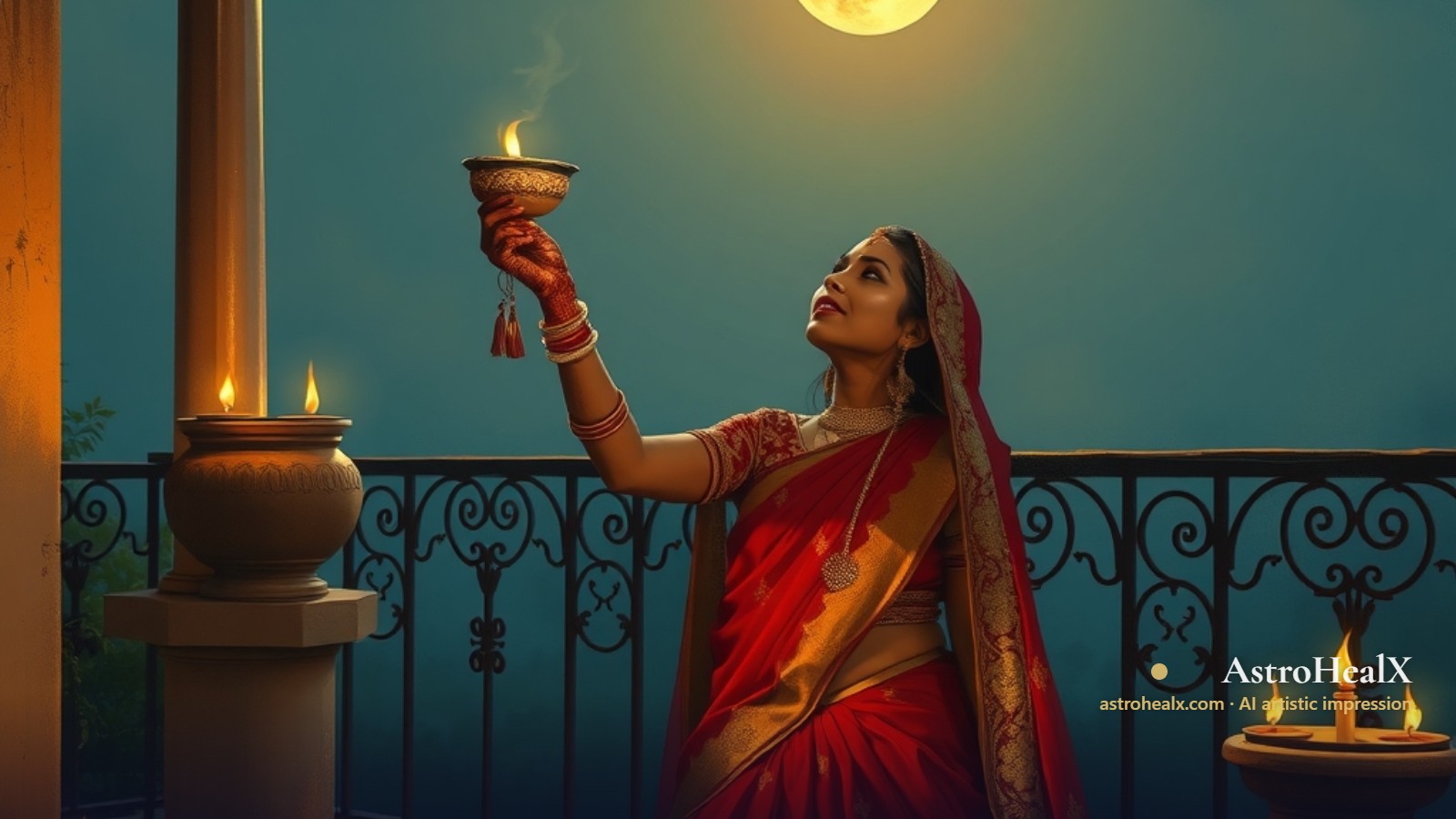
A sunrise-to-moonrise fast kept by married women for the husband's life, broken when the moon is seen through a sieve and water is offered from the karwa.
| When | Kartik Krishna Chaturthi (purnimanta) — four days after Sharad Purnima, nine before Diwali. 2026: Thursday 29 October; moonrise ≈ 8:00–8:30 pm in Delhi (check your city). |
|---|---|
| Deity | Parvati–Shiva, Ganesh and Kartikeya; Chauth Mata; the Moon |
| Where | Punjab, Haryana, Delhi, Rajasthan, UP, MP, Himachal, Gujarat; now across India |
Origin and scripture
A north-Indian vrat with Puranic echoes (the Karak Chaturthi of the Vamana and Skanda Puranas) and strong folk roots: the katha of Queen Veeravati, whose brothers tricked her into breaking the fast early by showing a false moon, and whose husband died until she kept the vrat properly; Savitri is also invoked. Karwa (karak) is the clay pot of water; chauth the fourth day. It likely began as a friendship rite between women in a new household (the kangan-saheli/"god-sister" bond) before becoming a husband-centred vrat.
The vidhi, step by step
- Sargi before dawn — Before sunrise the woman eats the sargi sent by her mother-in-law — fruit, dry fruit, sweets, pheni/seviyan, a little paratha — and water. From sunrise nothing, not even water, until the moon.
- The day — Mehndi, the red/bridal outfit, sixteen adornments; a baya (gift of clothes, sweets, a karwa and coins) is given to the mother-in-law. No housework that strains; rest is traditional.
- Evening puja and katha — Women gather in a circle around an image of Gauri/Chauth Mata (often drawn on the wall or a calendar) with Ganesh and the moon; each holds a decorated karwa and a thali with a lamp, rice, sweets. The katha of Veeravati is read by an elder; the thalis are passed around the circle seven times (pheri) with the song "Veero kudiye Karwara…". Water and roli are offered to the image.
- Moonrise — When the moon is seen, the woman offers arghya from the karwa toward it, looks at it through a sieve (channi) with the lamp in the sieve, then at her husband through the same sieve; he gives her the first sip of water and a morsel — the fast ends. The karwa water is kept or poured at the tulsi.
Samagri
- Two clay karwas (one to keep, one to give), with lid and a wick-spout; decorated with paint
- Sieve (channi), thali, lamp, roli, akshat, mauli, sweets, mathri
- Gauri/Chauth Mata image or a clay Gauri; Ganesh
- Sargi items; baya for the mother-in-law; red chunri, bangles, sindoor
- Karwa Chauth katha book
Mantras
To the Moon
ॐ सोमाय नमः
oṃ somāya namaḥ
Salutations to Soma, the moon. (Traditional Navagraha)
To Gauri
ॐ गौर्यै नमः
oṃ gauryai namaḥ
Salutations to Gauri (Parvati). (Traditional)
Do
- Eat and drink well in the sargi; those who are pregnant, diabetic or unwell may keep a fruit/water fast — the tradition allows it and the katha itself values the husband's wellbeing over rigidity
- Confirm moonrise for your city (it varies by 30–40 min across north India)
- Many couples now fast together; nothing in the vidhi forbids it
Don't
- Do not break the fast on a reflected or "false" moon (the katha's whole point) — wait for the actual moon or the panchang time if clouded
- Do not use scissors/needles or quarrel during the day (folk rules)
हिंदी में — करवा चौथ
पति की दीर्घायु के लिए विवाहित स्त्रियों का सूर्योदय से चंद्रोदय तक व्रत, छलनी से चंद्र-दर्शन और करवे से अर्घ्य पर समाप्त।
उत्तर भारतीय व्रत जिसकी पौराणिक गूँज (वामन और स्कंद पुराण की करक चतुर्थी) और प्रबल लोक-जड़ें हैं: रानी वीरावती की कथा, जिसके भाइयों ने झूठा चंद्रमा दिखाकर व्रत तुड़वाया और पति तब तक मृत रहा जब तक व्रत विधिवत न हुआ; सावित्री भी स्मरित। करवा (करक) मिट्टी का जलपात्र; चौथ चौथा दिन। संभवतः नए घर में स्त्रियों के बीच मैत्री-रस्म (कंगन-सहेली) से आरंभ होकर पति-केंद्रित व्रत बना।
भोर से पहले सरगी — सूर्योदय से पहले सास की भेजी सरगी — फल, मेवा, मिठाई, फेनी/सेवइयाँ, थोड़ा परांठा — और जल। सूर्योदय से चंद्रमा तक कुछ नहीं, जल भी नहीं।
दिन — मेहँदी, लाल/वैवाहिक वस्त्र, सोलह शृंगार; सास को बाया (वस्त्र, मिठाई, करवा, सिक्के)। थकाने वाला गृहकार्य नहीं; विश्राम परंपरा है।
Sources: Vamana Purana; Skanda Purana (Karak Chaturthi) · Folk katha of Veeravati (north Indian oral tradition). Family and regional custom take precedence.
This page is the readable version. The interactive view has the full reader, search and related tools.
Open in AstroHealX