Chhath Puja · छठ पूजा
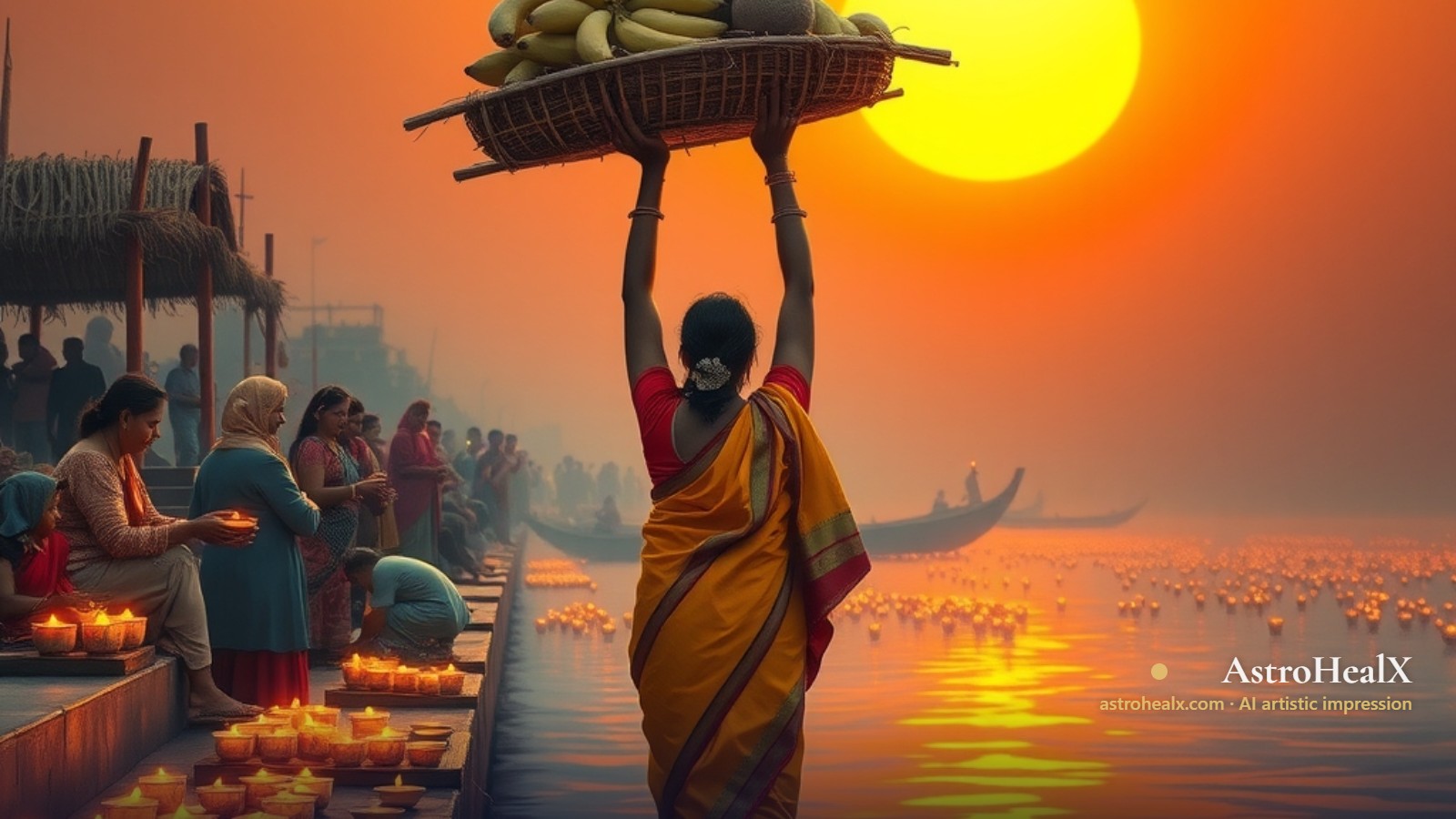
The four-day sun festival of Bihar, Jharkhand, eastern UP and the Nepal Terai — the only major puja where the setting sun is worshipped before the rising one.
| When | Kartik Shukla Shashthi — the sixth day after Diwali — with the four days running Chaturthi to Saptami (October–November). A second, smaller Chhath falls on Chaitra Shukla Shashthi (March–April), called Chaiti Chhath. |
|---|---|
| Dates | 2026: Nahay Khay Fri 13 Nov · Kharna Sat 14 Nov · Sandhya Arghya Sun 15 Nov (sunset ≈ 5:00–5:30 pm in Patna) · Usha Arghya Mon 16 Nov (sunrise ≈ 6:15–6:30 am). Chaiti Chhath 2026 fell 23–26 March. 2027 (approx.): 4–7 November. Always confirm sunrise/sunset for your city with a local panchang. |
| Deity | Surya (the Sun) and Chhathi Maiya (Shashthi Devi — Usha and Pratyusha, the dawn and dusk) |
| Where | Bihar, Jharkhand, eastern Uttar Pradesh (Purvanchal), the Nepal Terai (Mithila, Madhesh); and wherever people from there live — Delhi, Mumbai, Kolkata, Mauritius, Fiji, Trinidad, Suriname, Guyana, the Gulf, the US and UK. |
Who is worshipped
Chhathi Maiya is Shashthi Devi — in the Brahmavaivarta Purana a manifestation of Prakriti (the sixth part, hence Shashthi) who protects children and grants offspring; in the folk understanding of Bihar she is the Sun's sister, and the two dawns, Usha and Pratyusha, are worshipped with him. There is no temple-idol tradition for her: her form is the river, the sun and the soop (winnowing basket) of offerings. Because of this the festival needs no priest — the vrati (the one who fasts, usually a woman but increasingly men too) performs everything.
Origin and scripture
Sun worship at dusk and dawn with water offerings is as old as the Rigveda (1.50, 1.115, the Gayatri 3.62.10 is addressed to Savitr, the sun). The specific festival is first attested in Mithila–Magadh tradition and grew from the Vedic arghya into a women's vrat without priests. Patna's Deo (Aurangabad) Sun temple, Baragaon near Nalanda and the Chhath ghats of Patna are its oldest centres. Historians note that the Magadh region had a strong Saura (sun-worshipping) tradition in the Gupta period; the folk festival is the living descendant of that.
Legends
Karna, son of the Sun
The most-told origin in Bihar: Karna of the Mahabharata, born of Kunti and Surya and king of Anga (Bhagalpur–Munger), stood waist-deep in the Ganga every day offering arghya to his father the Sun and gave alms to whoever came. The Chhath arghya in water is remembered as his practice.
Draupadi and the Pandavas
On the sage Dhaumya's advice Draupadi kept the Surya Shashthi vrat during the exile; the Sun gave Yudhishthira the inexhaustible vessel (akshaya patra) that fed their guests, and the vrat is credited with the recovery of their kingdom.
Rama and Sita at Munger
Returning from Lanka, Rama and Sita are said to have kept a fast and offered arghya to the Sun on Kartik Shukla Shashthi at Munger on the Ganga, where Sita Charan temple marks the spot; Ayodhya's Sarayu ghats keep the same tradition.
King Priyavrata and Shashthi Devi
From the Brahmavaivarta Purana (Prakriti Khanda): the childless King Priyavrata's son was stillborn; Shashthi Devi appeared, revived the child and taught the king her worship on the sixth day — the root of Chhathi Maiya as protector of children and of the sixth-day (chhathi) ceremony after a birth.
Why it matters
Chhath is the festival of gratitude without intermediaries: no idol, no priest, no caste bar, no expense that a poor household cannot meet. The vrati fasts 36 hours without water, stands in cold river water at dusk and at dawn, and offers whatever the earth gave — sugarcane, coconut, banana, water-chestnut, turmeric and ginger plants, thekua made at home. Offering to the setting sun first is read as thanking the day that is ending before asking anything of the one to come. It is also the one festival where the whole family — and the whole neighbourhood — cleans the river bank.
The vidhi, step by step
- Day 1 — Nahay Khay (Kartik Shukla Chaturthi) — The vrati bathes in a river or pond (or at home with Ganga water added), the house and especially the kitchen are scrubbed, and a single sattvic meal is cooked on a fresh clay or bronze stove with wood or cow-dung fire: arwa (sun-dried) rice, chana dal and lauki (bottle gourd) in pure ghee, with rock salt only. The vrati eats first, then the family. From this meal the vrati sleeps on the floor and eats nothing cooked by others.
- Day 2 — Kharna / Lohanda (Panchami) — A full day's fast without water. After sunset the vrati cooks rasiao-kheer (rice pudding in jaggery, never sugar), wheat rotis and sometimes a banana offering, on the same clay stove, offers it to Chhathi Maiya with a lamp and incense in a quiet, closed room, and then breaks the fast with this prasad — in complete silence, because the moment any sound or a request is heard the eating stops. The prasad is then distributed to everyone. From this meal begins the 36-hour nirjala (waterless) fast.
- Day 3 — Sandhya Arghya (Shashthi): the evening offering — The day is spent preparing prasad: thekua (wheat flour, jaggery/sugar, ghee, pressed in a wooden mould and fried), kasar (rice-flour laddoos), and arranging the soop and daura — bamboo winnowing baskets and a large bamboo basket — with fruits and the offerings listed below. In the afternoon the family walks in procession to the ghat, the man carrying the daura on his head, the vrati walking barefoot, often with women singing. At the ghat a small earthen altar (koshi, with sugarcane canopy and lamps) may be made. As the sun nears the horizon the vrati stands in the water facing west, holding each soop up in turn while a family member pours milk and water over it from a lota toward the sun; everyone present offers arghya. The sun is watched until it sets. The family returns home; the vrati stays awake, often with the koshi lamps lit at home through the night.
- Day 4 — Usha Arghya / Parana (Saptami): the dawn offering — Before first light the family is back at the ghat with the same soops, now facing east. The vrati stands in the water as the sky lightens and offers arghya to the rising sun — the moment the disc appears is greeted with "Jai Chhathi Maiya". After the offering the vrati asks forgiveness for any lapse, elders bless the family at the ghat, and the prasad from the soops is distributed to everyone on the bank — refusing none. Back home the vrati breaks the 36-hour fast (parana) with ginger and water, then kheer or thekua, and the family eats together.
Samagri
- Bamboo soop (winnowing basket), 2–7, and a daura (large basket) — bamboo, never metal or plastic
- Sugarcane with leaves, 5 or 7 canes (also for the koshi canopy)
- Thekua, kasar and rice laddoos made at home
- Fruits with skin: banana (whole bunch), coconut with water, water-chestnut (singhara), sweet lime, pomelo (gagal), custard apple, apple, pear
- Turmeric and ginger plants with leaves; radish with leaves; sweet potato (suthni)
- Rice (arwa), wheat, chana, lentils for the Nahay Khay and Kharna meals
- Jaggery (gur) for the Kharna kheer; pure ghee
- Sindoor (long orange line from nose to parting for the vrati), alta, new cloth (saree/dhoti, yellow or red)
- Clay or bronze lamps (diya), camphor, incense, wicks, mustard oil
- Copper or brass lota for arghya; milk; Ganga water if available
- Betel leaf and nut, cloves, cardamom, honey
- Kalash (optional), earthen koshi lamps (for a vow fulfilled)
Prasad
Thekua is the heart of it — wheat flour kneaded with jaggery water and ghee, scented with fennel or cardamom, pressed on a carved wooden saancha and fried in ghee; it keeps for days and travels across the world. Rasiao-kheer with jaggery on Kharna; kasar laddoos; every fruit in the soop is prasad once offered. Nothing is bought ready-made if it can be made at home; nothing is tasted before offering; onion and garlic do not enter the kitchen from Nahay Khay to parana.
Mantras
Arghya mantra to the Sun (traditional)
एहि सूर्य सहस्रांशो तेजोराशे जगत्पते। अनुकम्पय मां भक्त्या गृहाणार्घ्यं दिवाकर॥
ehi sūrya sahasrāṃśo tejorāśe jagatpate | anukampaya māṃ bhaktyā gṛhāṇārghyaṃ divākara ||
Come, O Sun of a thousand rays, mass of light, lord of the world; have compassion on me, and accept this arghya offered with devotion, O maker of day. (Traditional Surya-arghya verse used across north India)
Rigveda 1.50.1 — the hymn to Surya
उदु त्यं जातवेदसं देवं वहन्ति केतवः। दृशे विश्वाय सूर्यम्॥
ud u tyaṃ jātavedasaṃ devaṃ vahanti ketavaḥ | dṛśe viśvāya sūryam ||
His rays bear up the god who knows all beings, the Sun, that all may look upon him. (Rigveda 1.50.1 (Griffith/public domain))
Surya Gayatri
ॐ आदित्याय विद्महे दिवाकराय धीमहि। तन्नः सूर्यः प्रचोदयात्॥
oṃ ādityāya vidmahe divākarāya dhīmahi | tanno sūryaḥ pracodayāt ||
We know Aditya; we meditate on the maker of day; may Surya inspire us. (Traditional Gayatri form)
Seed mantra
ॐ घृणिः सूर्याय नमः
oṃ ghṛṇiḥ sūryāya namaḥ
Om — salutations to the radiant Sun. (Traditional; also "ॐ ह्रां ह्रीं ह्रौं सः सूर्याय नमः")
For Chhathi Maiya
ॐ षष्ठी देव्यै नमः
oṃ ṣaṣṭhī devyai namaḥ
Salutations to Shashthi Devi. The Shashthi Devi Stotra (Brahmavaivarta Purana, Prakriti Khanda 43) is recited by those who know it; most families simply sing the Chhath geet. (Brahmavaivarta Purana)
Do
- Keep the house, kitchen and the route to the ghat clean from Nahay Khay onward; the vrati bathes before every cooking
- Cook prasad only in ghee, on a fresh stove, with rock salt; wash grains and sun-dry them beforehand
- Offer arghya standing in water if possible; where there is no river, a clean artificial pond, a large tub or even a bucket at home is accepted
- Distribute prasad to everyone at the ghat, including strangers — that is part of the vrat
- Let the vrati rest; the family carries, cooks the ordinary meals, and keeps noise down on Kharna evening
Don't
- No onion, garlic, meat, alcohol or packaged food in the household during the four days
- Nothing tasted before it is offered; no utensils used earlier for non-veg
- Do not step over the soop, prasad or the vrati's path; do not touch the prasad with unwashed hands
- No plastic in the soop or at the ghat; no detergents or idol-immersion — Chhath leaves nothing in the river
- Do not force the nirjala fast on anyone who is ill, pregnant or elderly — the tradition allows another family member to keep it on their behalf (an "arghya by proxy")
Where to see it
Patna's Ganga ghats (Gandhi, Collectorate, Digha, Kurji — several lakh people), Deo Sun Temple in Aurangabad (the most famous Chhath site, a west-facing temple), Baragaon and Ongari near Nalanda, Munger's Sita Charan, Varanasi's ghats (Assi to Dashashwamedh), Ayodhya's Sarayu, Ranchi's Hatia and Kanke dams, Janakpur in Nepal; and in Delhi (Yamuna ghats, ITO), Mumbai (Juhu), Kolkata (Hooghly ghats) the migrant communities' celebrations. Visitors are welcome at every ghat; arrive an hour before sunset, keep off the water's edge where the vratis stand, and accept prasad when offered.
Questions people ask
Can a man keep the Chhath vrat?
Yes. It is traditionally kept by women for the family's wellbeing, but men keep it too, especially for a vow (mannat), and the arghya is offered by everyone present.
Can it be done at home without a river?
Yes — a clean tub or a temporary pond on the terrace, facing the actual sun, is widely used by families abroad. The vrat, the prasad and the two arghyas are what matter.
What if the sun is hidden by cloud?
Offer the arghya at the panchang time of sunset/sunrise facing the direction of the sun; the offering is to the Sun, not to the sighting.
Why is the setting sun worshipped first?
Tradition reads it as gratitude for what has been received before any new request, and as honouring Pratyusha (dusk) and Usha (dawn) equally — the two consorts of the Sun. Folk explanation also says the evening sun is gentle, like a mother, and may be looked at.
Is Chhath a Hindu-only festival?
In practice no: in Bihar and the Terai, families of several communities keep it or help at the ghats, and there is no priest or initiation involved.
हिंदी में — छठ पूजा
बिहार, झारखंड, पूर्वी उत्तर प्रदेश और नेपाल तराई का चार दिवसीय सूर्य-पर्व — एकमात्र बड़ी पूजा जिसमें उगते से पहले डूबते सूर्य की उपासना होती है।
जल-अर्घ्य के साथ संध्या और प्रातः की सूर्य-उपासना ऋग्वेद जितनी प्राचीन है (1.50, 1.115; गायत्री 3.62.10 सविता-सूर्य को संबोधित)। यह विशेष पर्व मिथिला-मगध परंपरा में पहले प्रमाणित है और वैदिक अर्घ्य से बिना पुरोहित के स्त्रियों के व्रत में विकसित हुआ। देव (औरंगाबाद) का सूर्य मंदिर, नालंदा के पास बड़गाँव और पटना के छठ घाट इसके प्राचीनतम केंद्र हैं। इतिहासकार मानते हैं कि गुप्त काल में मगध में प्रबल सौर परंपरा थी; लोक-पर्व उसी का जीवित वंशज है।
दिन 1 — नहाय-खाय (कार्तिक शुक्ल चतुर्थी) — व्रती नदी या तालाब में स्नान करता है (या घर पर गंगाजल मिलाकर), घर और विशेषकर रसोई धोई जाती है, और नए मिट्टी या काँसे के चूल्हे पर लकड़ी या गोइठे की आग से एक सात्विक भोजन बनता है: अरवा चावल, चने की दाल, शुद्ध घी में लौकी, केवल सेंधा नमक। पहले व्रती खाता है, फिर परिवार। इस भोजन के बाद व्रती भूमि पर सोता है और दूसरों का बनाया नहीं खाता।
दिन 2 — खरना / लोहंडा (पंचमी) — पूरे दिन निर्जला उपवास। सूर्यास्त के बाद व्रती उसी मिट्टी के चूल्हे पर रसियाव-खीर (गुड़ की खीर, चीनी कभी नहीं), गेहूँ की रोटी और कभी केला बनाकर बंद, शांत कक्ष में दीप-धूप से छठी मैया को अर्पित करता है, फिर इसी प्रसाद से व्रत खोलता है — पूर्ण मौन में, क्योंकि कोई आवाज़ या पुकार सुनते ही भोजन रुक जाता है। फिर प्रसाद सबको बाँटा जाता है। इस भोजन से 36 घंटे का निर्जला व्रत आरंभ।
Sources: Rigveda 1.50, 1.115, 3.62.10 · Brahmavaivarta Purana, Prakriti Khanda, ch. 43 (Shashthi Devi) · Mahabharata, Vana Parva (Draupadi's Surya vrat; Dhaumya) · Field practice as recorded in Bihar/Mithila ethnographies and standard panchangs; dates: Drik/standard panchang for 2026. Family and regional custom take precedence.
This page is the readable version. The interactive view has the full reader, search and related tools.
Open in AstroHealX